1.2 Effect of controls
For a live overview of my flight lessons, visit: https://flighttools.justinverstijnen.nl/flightlessontracker
This page can contain a collection of personal notes, steps to remember, finished and unfinished content. Please excuse brevity.
Do not use specific information given like fuel flow, landing/take-off distances for your flights. Always refer to the POH of your exact plane for flight preparation. My information is just for references that I used.
Introduction
| Lesson number | Lesson name | Lesson date(s) |
|---|---|---|
| 1.2 | Effect of controls | 08-08-2025 |
In this lesson, we went more into the technical limitations of the Cessna 172 aircraft. Also we did some slow-flight exercises to be somewhat ahead of schedule as we had some spare time.
Limitations
The most important limitations of the Cessna 172 aircraft are:
- Maximum take-off weight (2300 LBs / 1.043 KG)
- Maximum Indicated Airspeed (IAS) of 140 kts (260 km/u) while flapless
- Maximum Indicated Airspeed (IAS) of 85 kts (157 km/u) while full flaps
(check the white arc for allowed flap speed on the airspeed indicator) - Minimum landing distance
- Minimum take-off distance
To make sure we don’t exceed these limitations, we need to take several precautions.
For weight, we perform a mass and balance calculation.
For airspeed, we ensure during flight that we remain well below 140 knots.
For landing and take-off distance, this is ensured during flight preparation, where penalties are added for unfavorable runway or weather conditions.
Mass and Balance sheet
Before we begin our flight, we must calculate both weight and balance. They play a critical role in aircraft performance. The total mass must always remain below the maximum take-off weight, which is specific to each aircraft type.
The root of why we calculate this before the flight is to ensure we stay within the aircrafts performance envelope and not to create imbalance. Doing this incorrectly can lead to decreased flight perforrmance and even worse results.
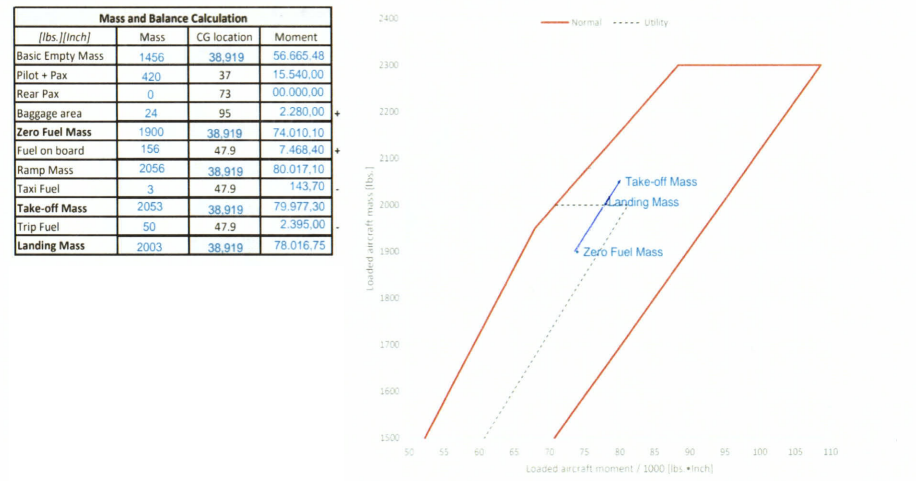
Here I created a mass and balance sheet for a Cessna 172, fully within the technical limits of the aircraft.
- Normal category flights must stay within the red lines
- Utility/aerobatic flights must stay within the grey dotted lines
The CG (Center of Gravity) is the balance point of the aircraft.
You can compare it to balancing a pencil on your finger: the point where it stays perfectly balanced is the center of gravity.
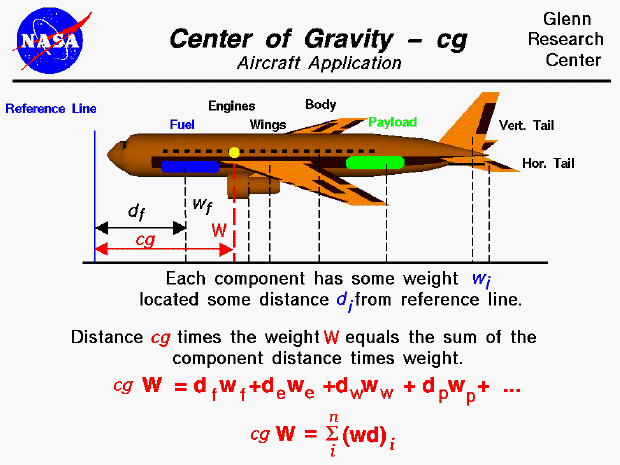
In an aircraft, CG is calculated along the fuselage. For the Cessna 172 this is measured in inches.
For example: a baggage CG of 95 means the weight is centered 95 inches from the front of the fuselage.
Emergency equipment
In a Cessna 172, the following 7 emergency items must always be on board:
- First aid kit
- Fire extinguisher
- Emergency Locator Transmitter (ELT)
- Radios / avionics
- Transponder
- Emergency checklist (QRH)
- Mobile phone and emergency contacts:
- FIO
- ACC Supervisor
During the before‑take‑off checklist, I learned these items by heart and was told to always be aware of them.
Calculating Take-off and Landing Distances
Before confirming that we can safely take off or land on a specific runway, we calculate the required distances.
Runway lengths for all Dutch aerodromes can be found via the AIP:
https://www.lvnl.nl/diensten/aip?mark-word=eais
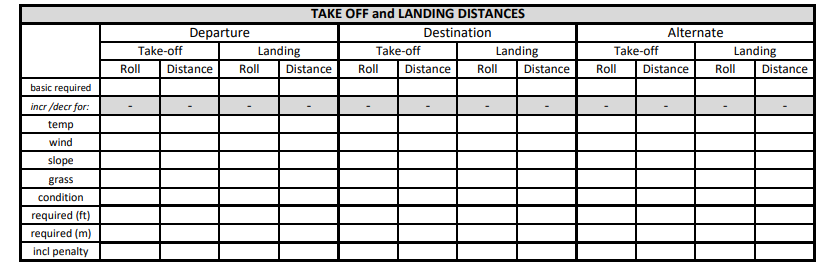
Cessna publishes the basic required take-off and landing distances in the POH (Pilot Operating Handbook):
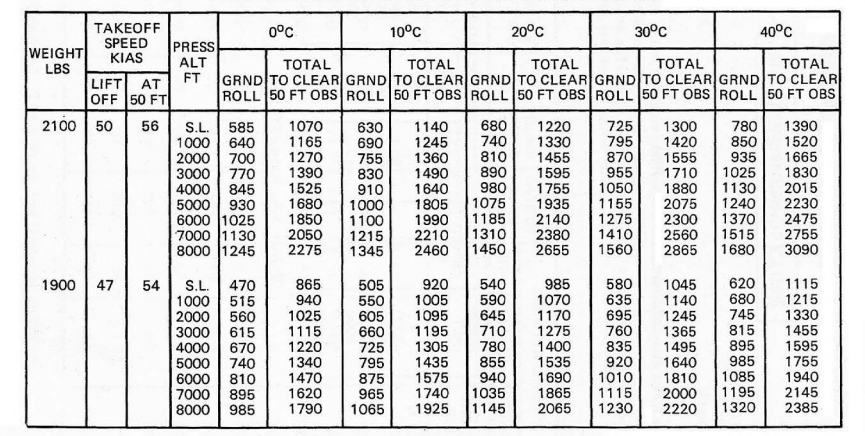
These values assume perfect conditions: zero wind, ideal temperature, dry asphalt runway.
Because this rarely happens, we apply penalties and always calculate using worst‑case scenarios.
Take-off distance penalties
| Penalty description | Increase basic required take‑off distance |
|---|---|
| Every 100 ft aerodrome elevation above AMSL | +1% |
| Every °C above OAT | +1% |
| Headwind (per knot) | −1% |
| Tailwind (per knot) | +20% |
| Runway slope (uphill, per 1%) | ≥ 5% |
| Grass runway – dry | +25% |
| Grass runway – wet | +30% |
| Soft ground | ≥ 25% |
| Snow | ≥ 25% |
| Gravel | +7% |
| Flapless take-off | +60% |
This prevents discovering at 45 knots that the runway is too short.
Worst‑case thinking is essential.
Landing distance penalties
| Penalty description | Increase basic required landing distance |
|---|---|
| Every 100 ft aerodrome elevation above AMSL | +0.5% |
| Every °C above OAT | +0.5% |
| Headwind (per knot) | −1% |
| Tailwind (per knot) | +20% |
| Runway slope (downhill, per 1%) | ≥ 5% |
| Grass runway – dry | +30% |
| Grass runway – wet | +38% |
| Soft ground | ≥ 25% |
| Snow | ≥ 25% |
| Gravel | +7% |
| Flapless landing | +60% |
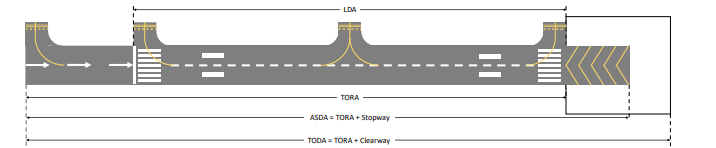
Always verify the Landing Distance Available (LDA) — the space between the white runway stripes.
Do not confuse this with TORA or TODA, which apply to take‑off.
Runway surface conditions
There are four runway surface conditions:
- Dry – Best braking and performance
- Damp – Slightly moist, not shiny
- Wet – Shiny runway, water < 3 mm
- Contaminated – Water > 3 mm or snow
Always assess the worst section of the runway.
If 1100 m is dry but 400 m is wet, the runway is considered wet.
Example of my flight preparation
After lesson 2, I prepared a full fictional flight to practice all calculations:
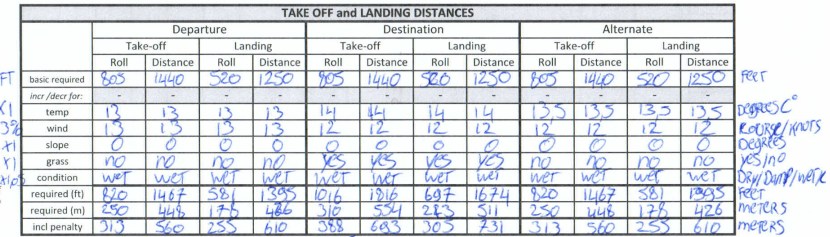
I used worst‑case values and rounded everything up when converting from feet to meters.
(Please ignore the handwriting 😄)
Slow Flight
We finished the lesson with slow‑flight exercises.
Slow flight is the art of controlling the aircraft at low airspeeds. Less airflow means less control authority.
As airspeed decreases, lift decreases. To compensate, we must increase the angle of attack by raising the nose.
Aircraft control in slow flight (~60 knots):
- Direction / heading": Rudder
- Airspeed: Elevator
- Altitude: Throttle
We also practiced with flaps extended, which increases lift and makes slow flight easier.
Finishing up
After completing the exercises, we returned to the airstrip for a smooth landing and taxied back to the flight school.
End of the page 🎉
You have reached the end of the page. You can navigate through other blog posts as well, share this post on X, LinkedIn and Reddit or return to the blog posts collection page. Thank you for visiting this post.
Support the blog
