1.5 Airwork 3
For a live overview of my flight lessons, visit: https://flighttools.justinverstijnen.nl/flightlessontracker
This page can contain a collection of personal notes, steps to remember, finished and unfinished content. Please excuse brevity.
Do not use specific information given like fuel flow, landing/take-off distances for your flights. Always refer to the POH of your exact plane for flight preparation. My information is just for references that I used.
Introduction
| Lesson number | Lesson name | Lesson date(s) |
|---|---|---|
| 1.5 | Airwork 3 | 26-09-2025 |
In this lesson we performed several airwork exercises, preceded by theory briefings.
The focus was on aircraft control, procedures, and situational awareness.
Exercises covered:
- Basic climbing and descending to a specific altitude
- Memory items for emergency scenarios (QRH)
- Taxi briefing
- Take‑off briefing
- Normal turns (30° bank)
- Steep turns (45° bank)
Basic climbing and descending to a specific altitude
In cruise flight, we typically fly around 95 knots (175 km/h).
When climbing or descending to a new altitude, we must do this efficiently and precisely, avoiding overshooting or undershooting the target altitude.
Climbing (APT)
Important terminology- Altitude – Height above sea level (ft)- Attitude – Nose angle (pitch axis)
For a climb:
Use Vy (best rate of climb)
- Cessna 172: 75 knots
Use full throttle
Carburetor heat OFF (engine is already warm at high RPM)
Climb technique:
From straight and level flight at 2000 ft:
- Increase nose attitude until 75 knots
- Apply full throttle
- Trim as needed to reduce control pressure
50 ft before target altitude:
- Reduce nose attitude to slow the climb
At target altitude:
- Level off
- Accelerate to ~90–95 knots
- Set cruise RPM (~2300 RPM)
Descending (PAT)
Descending differs from climbing:
- No additional power needed
- Controlled primarily by power reduction and attitude
Descent procedure:
- Carburetor heat ON
- Reduce power to ~1700 RPM
- Set nose attitude for descent (~500 ft/min vertical speed)
Level‑off technique:
100 ft before target altitude
- Carburetor heat OFF
50 ft before target altitude
- Adjust pitch and power to level flight
Resume cruise:
- ~95 knots
- ~2300 RPM
Memory items in checklists
Aircraft Quick Reference Handbooks (QRH) contain checklists for various scenarios.
Some checklist items are marked as memory items which must be known by heart, as there is no time to read during the event.
Example: Fire during start
If fire occurs during engine start:
- Continue cranking for 5–10 seconds to try to suck the flames into the engine
If engine starts:
- Parking brake set
- 1700 RPM
- Prepare seatbelts, doors, fire extinguisher
- Wait max. 2 minutes/120 seconds
- If fire continues:
- Mixture cut‑off
- Throttle full open
- Fuel selector OFF
- Ignition OFF
- Master switch OFF
If engine does not start:
- Mixture cut‑off
- Throttle full open
- Continue cranking briefly
- Ignition OFF
- Master switch OFF
- Fuel selector OFF (if possible)
- Extinguish fire using any possible method
Memory items exist because delay can cost the aircraft and lives.
They must be learned per aircraft type.
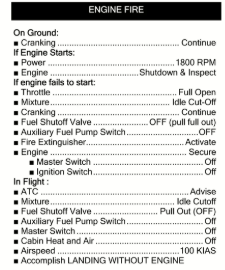
ImportantAlways learn memory items directly from the aircraft’s Quick Reference Handbook. Procedures can differ between aircraft types and models.
Magneto check
During the Before Take‑off checklist:
- Set magnetos to Right first
- Back to Both
- Set magnetos to Left
- Back to Both
This minimizes movement:
- Two counter‑clockwise
- Two clockwise
- One counter‑clockwise
- One clockwise
Airborne checks
While airborne, perform regular checks (once or twice per minute):
- Oil pressure
- RPM
- Engine temperatures
- Vacuum gauge
Additionally:
- Continuously scan for traffic using horizontal and vertical eye movement
- Deviate or perform a 180° turn if traffic is at the same altitude
- Be predictable, just like road traffic
- Make radio contact whenever possible
Briefings
Briefings are performed at the start of each flight phase to maintain shared situational awareness and reduce surprises.
We use the ANWB structure:
- Aircraft
- NOTAMs
- Weather
- Briefing
Taxi briefing
Performed during the Before Taxi checklist.
Items to brief:
Aircraft status (defects / remarks)
Relevant NOTAMs
Weather impact
Route to run‑up area
Taxi speed and RPM
Expected turns
Instruments to check:
- Turn coordinator (ball & symbol)
- Gyro / magnetic compass
- Heading indicator
Avoid hotspots and deviate from yellow line to avoid nose‑wheel chimneys
Effect of wind (counter‑steering)
Brake check when starting taxi
“Any questions?”
Departure briefing
Performed before take‑off.
Brief:
- Runway and usable length
- Flap setting (default: 10°)
- Power setting
- Rotation speed (55 knots)
- Climb speed after 200 ft
- Circuit height and exit (700 ft / 45°)
- Direction of departure
- Cruise altitude and speed
Emergency scenarios:
Before 55 knots
- Throttle idle
- Braking
- Inform ATC
After 55 knots – non‑flyable
- Forced landing ahead
- 30° left or right (wind‑dependent)
- Above 1000 ft: consider turn‑back
After 55 knots – flyable
- Stay in circuit at 700 ft
- Full‑stop landing
- Extra vigilance with gliders, parachuting or tow operations
Arrival briefing
Performed when approaching the destination airport.
Brief:
Aircraft status
Destination NOTAMs
Weather
Runway and usable landing distance
Flap setting (40°, adjust for wind)
Circuit direction
Approach speed ( 65 knots )
Go‑around procedure:
- Complete circuit
- Line up for another attempt
End of the page 🎉
You have reached the end of the page. You can navigate through other blog posts as well, share this post on X, LinkedIn and Reddit or return to the blog posts collection page. Thank you for visiting this post.
Support the blog
