This is my blog section. Here all new blog posts will be showed in reverse-chronological order. Just a fancy way to say newest-top.
At the left, you can view the categories, and on the right you can find the tags and Table of contents.
This is the multi-page printable view of this section. Click here to print.
This is my blog section. Here all new blog posts will be showed in reverse-chronological order. Just a fancy way to say newest-top.
At the left, you can view the categories, and on the right you can find the tags and Table of contents.
This category contains the details of my flight lessons, where I dive into the theory of the exercises for review and the learning processes.
Lesson 1.7 – Stalls Dates: 03-11-2025 · 30-01-2026 · 27-03-2026 · 03-04-2026
This page contains all my notes for Lesson 1.7 – Stalls.
This was one of the hardest lessons so far, mainly due to the weather conditions in late 2025 and early 2026. The lesson was cancelled about five times, and on two occasions we were already airborne but had to abort because the weather deteriorated beyond the forecast.
For stalls training, the following weather conditions were required:
As a result, this lesson was flown four times, but only the last two were fully valid stalls lessons. Due to time constraints and repetition, multiple sessions were required.
The lesson was scheduled in the afternoon. Due to the transition from UTC+2 to UTC+1 (end of daylight saving time), darkness came earlier than usual.
Wind was around 14 knots, completely crosswind relative to the runway.
We completed the stalls briefing and theoretical explanation, performed pre‑flight checks, and departed. Shortly after take‑off it became clear that weather conditions would not allow a proper lesson.
After approximately 25 minutes airborne, we returned and scheduled a new flight.
This was my first flight lesson in three months, after roughly four cancellations.
In the meantime, I successfully completed:
Weather was again the limiting factor. It was a cold winter day with snow from earlier in the week, providing beautiful winter scenery.
At around 2000 ft (600 m) after take-off, we decided to abort the stall exercises due to an approaching cloud front. This resulted in a very nice airliner-like experience flying above the cloud layer before descending back to base for a smooth landing by my instructor.
After another cancellation and a vacation period, the weather finally cooperated.
Conditions:
We reviewed stall theory and briefings, checked NOTAMs, aircraft status and risks, and refueled the aircraft.
The stall exercises improved with repetition. Initially, I was too gentle both with inducing the stall and during recovery. After approximately four repetitions, the execution was considered proficient by the instructor.
Exercises performed:
I learned that stalls can occur at any time, especially with reduced focus or during circuit flying. Fast and correct recovery is essential for the safety of both pilot and passengers.
This was the second full stalls lesson.
Weather was slightly less favorable than the previous week but still good enough:
Exercises performed:
Recovery went better than the previous lesson, but several learning points remained:
Overall, the lesson went very well.
The crosswind take-off was the best so far, including crabbing technique, correct tracking, and altitude control. It remains a strange but fascinating sensation when heading and track differ due to wind.
Homework objectives for the next lesson:
A stall occurs when the wing exceeds its critical angle of attack, regardless of airspeed.
There are two main stages:
Symptoms of stall approach:
Immediate recovery actions:
⚠️ Important
Never use ailerons during stall recovery.
This worsens the asymmetrical angle of attack and reduces recovery effectiveness.
Follow-up checks (bottom‑to‑top, left scan):
Outside checks (APOS):
A full stall may present as:
Recovery actions are similar to stall‑approach recovery:
⚠️ Reminder
Never use ailerons during full stall recovery.
Follow with the same engine checks and APOS scan as after stall approach recovery.
When performing stalls in landing configuration, flaps must be reduced during recovery to decrease drag and increase acceleration.
Due to repeated cancellations, I was assigned homework to improve understanding of the relationship between:
The first exercise involved drawing a graph representing altitude versus distance from the start of the take‑off roll through rotation and initial climb, comparing flapless and flaps‑assisted take‑offs.
After another two months, we were finally able to successfully complete the stalls lesson on March 27. During this lesson, we reviewed all previously discussed information and repeated the stalls exercises in full.
Key items that needed extra review:
Lesson 1.6 – Slow Flight Date: 13-10-2025 & 20-10-2025
One of the harder lessons so far: slow flight.
The purpose of this lesson is to fly as slowly as possible while remaining safely airborne in the Cessna 172.
The first time we flew this lesson, it did not go as planned. I lost too much altitude and controlling the aircraft was difficult, especially because the exercise had to be maintained for an extended period of time. For this reason, I had to retake the lesson.
Before starting slow flight, we first scan for traffic, then begin the exercise.
Without flaps, we can safely fly at approximately:
With flaps extended, we can safely fly at approximately:
I found it very difficult to hold the aircraft in the correct attitude:
Maintaining heading is especially challenging, because at around 10° nose‑up attitude, outside visual references are limited. In this configuration, heading control relies almost entirely on inside instruments.
After about three attempts, I managed to perform the exercise correctly, but it was clear that repetition was needed.
During the second lesson (one week later), performance improved significantly:
The slowest speed achieved during slow flight was 49 knots (90 km/h), which is very close to the onset of a stall.
Tip
For unit conversions during flight preparation, I use my own tool:
https://flighttools.justinverstijnen.nl/unitcalculator
Fast flight was considerably easier and much more enjoyable.
During this exercise:
This is approximately the take‑off speed of large commercial aircraft such as:
After reaching maximum speed, power was reduced. You could clearly feel the aircraft slowing down.
At higher airspeeds:
After the flight, I was instructed to learn the taxi checks by memory.
These checks must be performed without using a checklist.
Taxi checks:
During the Before Take‑off checklist and magneto check, call‑outs are mandatory:
This lesson made it clear that an overall change in learning and preparation is needed.
Going forward, I will:
This should improve safety, confidence, and consistency during future lessons.
Lesson 1.5 – Airwork 3 Date: 26-09-2025
In this lesson we performed several airwork exercises, preceded by theory briefings.
The focus was on aircraft control, procedures, and situational awareness.
Exercises covered:
In cruise flight, we typically fly around 95 knots (175 km/h).
When climbing or descending to a new altitude, we must do this efficiently and precisely, avoiding overshooting or undershooting the target altitude.
Important terminology
- Altitude – Height above sea level (ft)
- Attitude – Nose angle
For a climb:
Climb technique:
Descending differs from climbing:
Descent procedure:
Level‑off technique:
Aircraft Quick Reference Handbooks (QRH) contain checklists for various scenarios.
Some checklist items are marked as memory items — these must be known by heart, as there is no time to read during the event.
If fire occurs during engine start:
If engine starts:
If engine does not start:
Memory items exist because delay can cost the aircraft and lives.
They must be learned per aircraft type.
https://justinverstijnen.nl/wp-content/uploads/2025/09/jv-media-4506-c381dd5277f4.png
Important
Always learn memory items directly from the aircraft’s Quick Reference Handbook.
Procedures can differ between aircraft types and models.
During the Before Take‑off checklist:
This minimizes movement:
While airborne, perform regular checks (once or twice per minute):
Additionally:
Briefings are performed at the start of each flight phase to maintain shared situational awareness and reduce surprises.
We use the ANWB structure:
Performed during the Before Taxi checklist.
Items to brief:
Performed before take‑off.
Brief:
Emergency scenarios:
Before 55 knots
After 55 knots – non‑flyable
After 55 knots – flyable
Performed when approaching the destination airport.
Brief:
Lesson 1.4 – Airwork 2 Date: 02-09-2025
We started by reviewing previous material and then went deeper into the theory of nose attitude.
During the flight we practiced slow flight, throttle effects on nose attitude, gliding, and trimming.
First, we discussed some theory.
At take-off, we use different speeds for different phases:
Vr – Rotation speed
Vx – Best angle of climb (maximum altitude gain for distance)
Vy – Best rate of climb (maximum altitude gain for time)
Vg – Best glide speed (engine failure)
These speeds are marked on the Garmin G1000 primary flight display:
https://justinverstijnen.nl/wp-content/uploads/2025/09/jv-media-4498-1dbb77554412.png
And they correspond to the take‑off phase like this:
https://justinverstijnen.nl/wp-content/uploads/2025/09/jv-media-4489-ac78e0128a47.png
During take-off:
Throttle input directly affects nose attitude:
When trimming and stabilizing the aircraft, throttle can be used to help level off and maintain a steady attitude.
During descent from approximately 2000 ft to 700 ft, we performed a glide.
While gliding, we trimmed the aircraft with a slightly nose‑up attitude. This resulted in minimal engine noise and was a great exercise for understanding glide paths during engine failure scenarios.
Trimming is essential for stable, level flight.
It means correcting pitch for a specific combination of throttle, altitude, pressure, and speed.
A correctly trimmed aircraft maintains altitude without continuous control input.
Procedure:
Trim logic:
Although this feels counter‑intuitive, it mirrors the direction you would move the yoke.
We practiced creating standardized briefings following the principle:
Say what you do, do what you say
https://justinverstijnen.nl/wp-content/uploads/2025/09/jv-media-4498-393b981f138d.png
Lesson 1.3 – Airwork 1 Date: 22-08-2025
In this flight, I learned how to perform the preflight inspection myself by doing the walk‑around using a structured checklist.
In this first checklist item, we look for reasons not to fly.
In IT terms, this can be compared to a physical risk assessment.
I had to repeat this with more steps and will do this every lesson to fully master the procedure.
https://justinverstijnen.nl/wp-content/uploads/2025/09/jv-media-4513-dc928e948c12.png
I performed the check as follows:
Cabin
Tail
Right wing
Right wheel & fuel
Nose
Left wheel & wing
Pitot & stall warning
Left aileron & flap
Aileron movement reminder
Steering left → left aileron up, right down
Steering right → right aileron up, left down
Wing going up produces more lift
Wing going down produces more drag
When fueling the aircraft, we must ensure enough fuel for every possible phase of the flight.
Fuel is not only for A → B — weather or runway issues might force a diversion.
https://justinverstijnen.nl/wp-content/uploads/2025/09/jv-media-4513-b99510c648fd.png
Fuel planning includes:
The final reserve fuel (30–45 minutes) must never be used.
Using it means the flight planning was insufficient.
Always filling tanks to the maximum may feel safe, but more fuel means:
Fuel consumption is calculated using data from the Pilot Operating Handbook (POH).
An aircraft is influenced by four main forces:
https://justinverstijnen.nl/wp-content/uploads/2025/09/jv-media-4513-e0407fd0f337.png
In straight and level flight, all four forces are in balance:
In this lesson, I learned to fly more visually by focusing on nose attitude instead of instruments alone.
This greatly helps maintaining a stable speed and altitude.
When flying straight or during turns:
Focus on how the horizon sits over the nose:
The carburetor mixes air and fuel.
Because intake air cools inside the carburetor, engine RPM drops (±150 RPM).
General rule:
Usage:
Carburetor icing can occur even on warm days.
Ice formation is detected by a rise in RPM when carb heat is applied.
Remember:
“No rise, no ice.”
Due to spare time, we practiced slow flight again.
By extending flaps, we increase lift and drag, allowing slower flight speeds — the reason flaps are used during landing.
Slow flight is also used in the circuit:
In slow flight, control dynamics change:
Lesson 1.2 – Effect of controls Date: 08-08-2025
In this lesson, we went more into the technical limitations of the Cessna 172 aircraft. Also we did some slow-flight exercises to be somewhat ahead of schedule and we had some spare time.
The most important limitations of the Cessna 172 aircraft are:
To make sure we don’t exceed these limitations, we need to take several precautions.
For weight, we perform a mass and balance calculation.
For airspeed, we ensure during flight that we remain well below 140 knots.
For landing and take-off distance, this is ensured during flight preparation, where penalties are added for unfavorable runway or weather conditions.
Before we begin our flight, we must calculate both weight and balance. They play a critical role in aircraft performance. The total mass must always remain below the maximum take-off weight, which is specific to each aircraft type.

Here I created a mass and balance sheet for a Cessna 172, fully within the technical limits of the aircraft.
The CG (Center of Gravity) is the balance point of the aircraft.
You can compare it to balancing a pencil on your finger: the point where it stays perfectly balanced is the center of gravity.

In an aircraft, CG is calculated along the fuselage. For the Cessna 172 this is measured in inches.
For example: a baggage CG of 95 means the weight is centered 95 inches from the front of the fuselage.
In a Cessna 172, the following 7 emergency items must always be on board:
During the before‑take‑off checklist, I learned these items by heart and was told to always be aware of them.
Before confirming that we can safely take off or land on a specific runway, we calculate the required distances.
Runway lengths for all Dutch aerodromes can be found via the AIP:
https://www.lvnl.nl/diensten/aip?mark-word=eais

Cessna publishes the basic required take-off and landing distances in the POH (Pilot Operating Handbook):

These values assume perfect conditions: zero wind, ideal temperature, dry asphalt runway.
Because this rarely happens, we apply penalties and always calculate using worst‑case scenarios.
| Penalty description | Increase basic required take‑off distance |
|---|---|
| Every 100 ft aerodrome elevation above AMSL | +1% |
| Every °C above OAT | +1% |
| Headwind (per knot) | −1% |
| Tailwind (per knot) | +20% |
| Runway slope (uphill, per 1%) | ≥ 5% |
| Grass runway – dry | +25% |
| Grass runway – wet | +30% |
| Soft ground | ≥ 25% |
| Snow | ≥ 25% |
| Gravel | +7% |
| Flapless take-off | +60% |
This prevents discovering at 45 knots that the runway is too short.
Worst‑case thinking is essential.
| Penalty description | Increase basic required landing distance |
|---|---|
| Every 100 ft aerodrome elevation above AMSL | +0.5% |
| Every °C above OAT | +0.5% |
| Headwind (per knot) | −1% |
| Tailwind (per knot) | +20% |
| Runway slope (downhill, per 1%) | ≥ 5% |
| Grass runway – dry | +30% |
| Grass runway – wet | +38% |
| Soft ground | ≥ 25% |
| Snow | ≥ 25% |
| Gravel | +7% |
| Flapless landing | +60% |
Always verify the Landing Distance Available (LDA) — the space between the white runway stripes.
Do not confuse this with TORA or TODA, which apply to take‑off.

There are four runway surface conditions:
Always assess the worst section of the runway.
If 1100 m is dry but 400 m is wet, the runway is considered wet.
After lesson 2, I prepared a full fictional flight to practice all calculations:

I used worst‑case values and rounded everything up when converting from feet to meters.
(Please ignore the handwriting 😄)
We finished the lesson with slow‑flight exercises.
Slow flight is the art of controlling the aircraft at low airspeeds. Less airflow means less control authority.
As airspeed decreases, lift decreases. To compensate, we must increase the angle of attack by raising the nose.
Aircraft control in slow flight (~60 knots):
We also practiced with flaps extended, which increases lift and makes slow flight easier.
After completing the exercises, we returned to the airstrip for a smooth landing and taxied back to the flight school.
Lesson 1.1 - Basics Date: 25-07-2025
In my first flight lesson for my Private Pilot Lesson, I have been introduced to multiple aspects of flying. In the past, around 3 years before this first PPL lesson, I did a trial lesson where I only controlled the plane at around 2.500 feet, but only controlled the yoke, rudder pedals and trims.
This lesson it was the first time after around 300 hours of Microsoft Flight Simulator where I controlled the plane for the full flight except the landing phase. In the PPL learning curve, you will perform this after around 8–9 lessons when doing take-off and landing/circuit exercises.
The theory of this lesson mostly consisted of:
Before we step into a plane, we are required to plan and prepare our flight. We don’t want to be unprepared when flying, and also both the pilot flying and pilot monitoring must be on the same pace.
My flight school uses the ANWB abbreviation for this:
In each stage we check all related things and we search for reasons or risks not to fly.
In the aircraft stage we check and calculate the following things:
NOTAMs (Notice to Air Missions) contain information about possible risks, such as:
We check NOTAMs for:
Weather is one of the most unpredictable factors. We check:
In the briefing phase we inform crew and passengers about:
These were all points from the flight preparation.
In aviation, multiple organizations oversee safety and regulations:
Before every flight we must perform a pre-flight inspection to avoid surprises in the air.
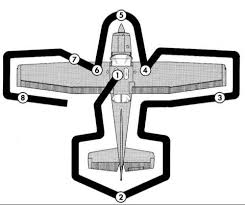
During the walk-around we check:
⚠️ Note
Pre-flight inspection steps differ per aircraft. Always refer to the official aircraft operating manual.
After confirming airworthiness, we proceed with engine start.
https://justinverstijnen.nl/wp-content/uploads/2025/09/jv-media-4509-0afa8a350fd1.png
Most training aircraft have a hot prop, meaning the propeller can start the engine if the magnetos are active. This is when the key is turned to R, L, Both or Start.
Therefore:
We then:
Taxiing is ground movement using taxiways marked with yellow center lines.
The run-up ensures engine reliability before take-off.
Before entering runway:
Before flying circuits (Upwind, Crosswind, Base leg), it helps to understand the pattern:
https://justinverstijnen.nl/wp-content/uploads/2025/09/jv-media-4509-f90ca74abc45.png
Hello


