Flight Lesson 1
Categories:
Lesson 1.1 - Basics Date: 25-07-2025
Introduction
In my first flight lesson for my Private Pilot Lesson, I have been introduced to multiple aspects of flying. In the past, around 3 years before this first PPL lesson, I did a trial lesson where I only controlled the plane at around 2.500 feet, but only controlled the yoke, rudder pedals and trims.
This lesson it was the first time after around 300 hours of Microsoft Flight Simulator where I controlled the plane for the full flight except the landing phase. In the PPL learning curve, you will perform this after around 8–9 lessons when doing take-off and landing/circuit exercises.
The theory of this lesson mostly consisted of:
- Flight preparation and planning
- Aircraft Technical Log (ATL) and Hold Item List (HIL)
- Standard Operating Procedures (SOPs)
- The multiple instances
- Performing a proper walkaround
Flight Preparation (ANWB)
Before we step into a plane, we are required to plan and prepare our flight. We don’t want to be unprepared when flying, and also both the pilot flying and pilot monitoring must be on the same pace.
My flight school uses the ANWB abbreviation for this:
- Aircraft
- NOTAMs
- Weather
- Briefings
In each stage we check all related things and we search for reasons or risks not to fly.
Aircraft
In the aircraft stage we check and calculate the following things:
- ABC: Departure airfield, destination and our alternate. We always must have a backup airfield.
- Aircraft Technical Log (ATL):
- All issues before maintenance are resolved
- First flight after maintenance: flight controls and trim check are critical
- Hold Item List (HIL): Flyable but inoperative items (e.g. autopilot or landing lights)
- Fuel calculation: Ensure enough fuel, including reserve and alternate
- Mass and Balance:
- Passenger and baggage weight affect fuel capacity
- Utility limits must be respected during aerobatics
NOTAMs
NOTAMs (Notice to Air Missions) contain information about possible risks, such as:
- Runway closures
- Military or government restrictions
- High cranes or temporary obstacles
- Defect obstacle lighting
- ILS or VOR outages
We check NOTAMs for:
- Departure airport
- Destination airport
- Alternate airport
- En-route
Weather
Weather is one of the most unpredictable factors. We check:
- SWC (Significant Weather Chart) – above 15,000 ft
- LLFC (Low Level Forecast Chart) – below 15,000 ft
- SIGWX
- GAFOR / GLLFC
Briefings
In the briefing phase we inform crew and passengers about:
- The route
- Destination aerodrome
- Threat and Error Management (TEM)
- Questions from passengers
These were all points from the flight preparation.
Aviation Instances
In aviation, multiple organizations oversee safety and regulations:
- ICAO: International procedures and recommendations
- EASA: European legally binding aviation rules
- LVNL: Dutch airspace authority
Performing the Pre-flight Inspection (Walk-around)
Before every flight we must perform a pre-flight inspection to avoid surprises in the air.
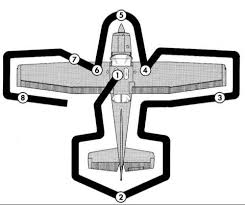
During the walk-around we check:
- Oil leaks
- Tires (grip and canvas)
- Brakes
- Ailerons
- Rudder
- Flaps
- Elevator
- Engine oil (min. 5 qt for C172)
- Fuel quantity and water
- Pitot cover removed
- ATL onboard
- Flight controls free and correct
⚠️ Note
Pre-flight inspection steps differ per aircraft. Always refer to the official aircraft operating manual.
Starting the Aircraft
After confirming airworthiness, we proceed with engine start.
https://justinverstijnen.nl/wp-content/uploads/2025/09/jv-media-4509-0afa8a350fd1.png

Most training aircraft have a hot prop, meaning the propeller can start the engine if the magnetos are active. This is when the key is turned to R, L, Both or Start.
Therefore:
- Key must be removed when outside the aircraft
- Propeller rotation can power magnetos
We then:
- Set seats and seatbelts
- Close doors and windows
- Complete Before Start checklist
- Mixture full rich
- Call: “On the brakes”
- Start the engine
Taxiing
Taxiing is ground movement using taxiways marked with yellow center lines.
- Ideal taxi speed: ~1000 RPM
- Speed comparable to a light sprint
- Airspeed indicator becomes active around 35–40 knots (too fast for taxi)
Run-Up (Before Take-off Checklist)
The run-up ensures engine reliability before take-off.
- Engine at ~1700–1800 RPM
- Test both magnetos
- Burn excess fuel if needed
- Bring engine to operating temperature
Before entering runway:
- Transponder: ALT
- Flaps: 10 degrees
- Trim: Take-off position
Airport Circuit
Before flying circuits (Upwind, Crosswind, Base leg), it helps to understand the pattern:
https://justinverstijnen.nl/wp-content/uploads/2025/09/jv-media-4509-f90ca74abc45.png
