PPL Theory - Human Performance & Limitations (HPL)
Categories:
Exam passed on April 4 2026.
For a live overview of my flight lessons, visit: https://flighttools.justinverstijnen.nl/flightlessontracker
This page can contain a collection of personal notes, steps to remember, finished and unfinished content. Please excuse brevity.
Do not use specific information given like fuel flow, landing/take-off distances for your flights. Always refer to the POH of your exact plane for flight preparation. My information is just for references that I used.
Breath and effect of low blood pressure (1)
In aviation, we are mostly in environments of low air pressure. As we go further up in the air, the pressure goes down. This will have some effects on humans, where we could have hypoxia and barotrauma.
Hyperventilation and carbon dioxide-poisoning will play together with breathing and the effect on blood gasses. We will take a look into them all.
The air in the troposphere
In the Troposphere (0-36.000ft), we have an air mass that consists of the following components:
| Gasses | Symbol | Concentration |
| Nitrogen (Stikstof) | N₂ | 78,1% |
| Oxygen (Zuurstof) | O₂ | 21,0% |
| Several noble gasses (edelgassen) | Not applicable | < 0,1% |
| Water vapor | H₂O | 0,1 - 1% |
Air pressure
As we already discussed this topic thoroughly in Meteorology, please take a look at there if you want to know more about air pressure: https://justinverstijnen.nl/ppl-theory-met/#air-pressure
The art of breathing
Organs and vessels in your body need energy to function properly. This energy will be generated by burning nutrients (voedingsstoffen). The process of burning nutrients is called oxidation. In this process, oxygen is used and as a result carbon dioxide which we breathe out. So the goal of breathing is to get energy.
Breathing conists of 3 phases which are in a never-ending circle:
- External respiration is the process of gas exchange between the lungs and blood
- The transport of oxygen and carbon dioxide from and to organs and body tissues
- Internal respiration is the gas exchange between the blood and the body tissues
The functions of why we breathe are:
- Transport of gasses between blood and lungs
- Cel-breathing between body cells
- Transport of carbon dioxide between vessels and organs and the lungs
- Transport of oxygen to organs and vessels
Because we need to actually be able to inhale and exhale air, the oxygen pressure in the lungs is lower than in the atmosphere. This is because breathing requires air to move in and out of the lungs. For that airflow to happen, the oxygen pressure inside the lungs must be lower than in the atmosphere.
The most important factor of breathing regulation is the carbon dioxide pressure in the blood.
Ventilation
Ventilation is the process where due to the movements of the breast carcass air is transported from and to the lungs. The capacity of a adult is around 6 litres. The vital capacity, usable capacity and actually filled part is around 4,5 litres.
- At rest, the breath frequency is around 15 per minute
- Every time, around 0,5 litres of air is inhaled, called the breathvolume
When breathing, the lungs fill up with air and the air will go through the small bronchi and bronchioles in the lungbladders. These lungbladders are called the Aleovi.
Alveoli and external respiration
The alveoli is responsable for the transport of gasses. Oxygen and other gasses in the air will go through the thin wall between lung bladders and blood. Simultaneously, carbon dioxide will flow through the blood back into the lung bladders, which is actually the external respiration. The blood rich of oxygen is then pumped from the lungs to the heart and other organs through the body.
The frequency and depth of breathing is primarily controlled by the carbon dioxide concentration in the blood.
Transport of oxygen in blood and internal respiration
Oxygen in blood will be transported by a special transport-protein called hemoglobin (Hemoglobine). This is a ron-containing protein which is located in the red bloodcells. This stuff is the cause of the red color blood has.
In the exchange of gasses in the alveoli, the hemoglobin will be almost fully (97%) saturated with oxygen. This oxygen-rich blood will be pumped through the body and body tissues. In the meanwhile, the body tissues will give back the carbon dioxide back to the blood. This is a description of the internal respiration.
When hemoglobin absorbs oxygen-molecules, the color will change:
- Oxygen rich blood is clearly red
- Oxygen-low blood is dark red
In cases where a person has less oxygen than needed, the skin will color blue. This process is called cyanosis (cyanose). This will be visible at the fingers or lips first.
Hemoglobin and its properties
The link between oxygen and hemoglobin depends on the amount of available oxygen in the alveoli. The higher the O₂ pressure, the higher the concentration of oxygen in the hemoglobin. This link can be seen in the graphic below:
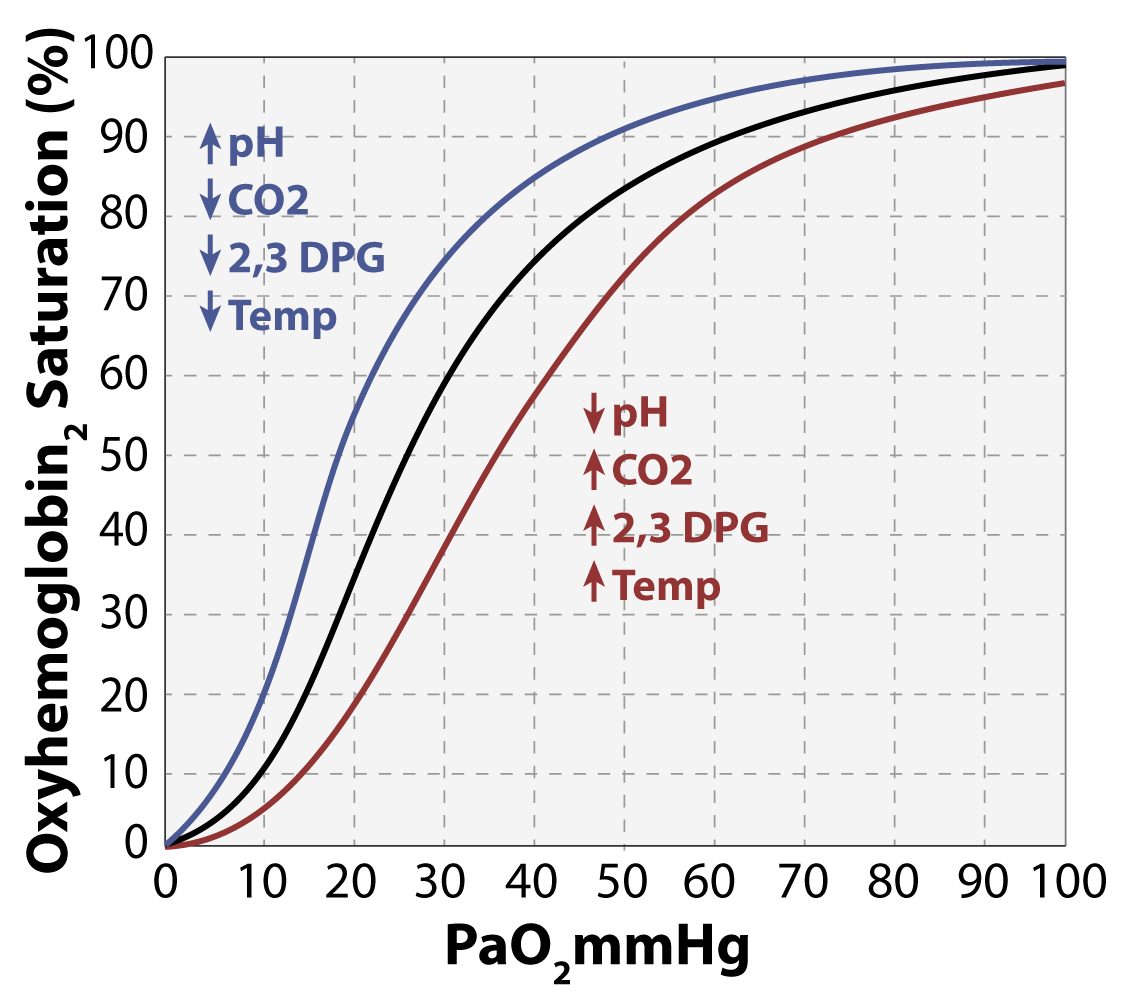
If you increase your flying altitude, the oxygen pressure will decrease. This will go slowly in the beginning of the graphic, but from around 70%, this will go very fast at the steep side of the curve. The curve can result in very fast change of symptoms.
Hypoxia
Hypoxia is a condition where a body gets too less oxygen. When exposed for the first time to an environment with low concentration of oxygen, you will not really feel a difference, because oxygen saved in the blood and body tissues can be used for a few minutes. After the oxygen supply is depleted, you will start feeling some really big differences:
- Impaired judgment and visual (especially at night)
- Reduced concentration
- Euphoria and or Overconfidence
- Headache
- Dizziness
- Fatigue
- Shortness of breath
The chance of getting hypoxia is different for every person, but some critera:
- Oxygen pressure (PaO₂) as stated in the graphic above
- Exposure time to less oxygen
- Oxygen usage of the body, this is linked to physical extertion (lichamelijke inspanning)
- Personal condition
- Better when not tired
- Better when not drinking
- Better when not smoking
- Better when not having a too high BMI
Because of night visuals are affected first, the maximum altitude without supplemental oxygen is 5.000ft instead of 10.000ft in daylight.
Fun fact: Hypo is a definition of: “Too less”, xy is a shortened version of Oxygen.
| Altitude (feet)* | Altitude (meters)* | Hypoxia Risk |
|---|---|---|
| 5.000 ft | 1.500 m | Night vision begins to deteriorate |
| 8.000 ft | 2.400 m | Mild hypoxia possible (especially sensitive individuals) |
| 10.000 ft | 3.000 m | Noticeable performance impairment |
| 12,000 ft | 3.700 m | Clear hypoxia symptoms likely |
| 14.000 ft | 4.300 m | Oxygen required (many regulations) |
| 18.000 ft | 5.500 m | Severe hypoxia without supplemental oxygen |
*Based on the pressure altitude
A rule of thumb is to remember the 5.000ft at night and 10.000ft at day as lines to not cross without forms of oxygen. Above 10.000 feet, you must have supplemental oxygen for everyone on board for 30 minutes or longer. From 13.000 feet and above, supplemental oxygen is mandatory.
Other causes of hypoxia
There are some other, way less occurring causes of hypoxia:
- Hypoxic: The oxygen pressure is too low
- Anemic Hypoxia: This is caused by a too low capacity of oxygen transportation in blood, due to blood loss, blood donation, exposure to carbon monoxide or Anemia (bloedarmoede).
- Ischemic Hypoxia: This is caused by a decrease of blood transportation to body tissues. Mostly occurring when exposed to G-forces. More on G-forces later
Carbon monoxide (CO)
Carbon monoxide is a highly poisonous gas without color or smell which arises when hydrocarbons not fully burn. Types of hydrocarbons (koolwaterstoffen) are:
- Oil products
- Gas
- Exhaust gasses (small percentage)
- Cigarette smoke (small percentage)
Carbon monoxide is highly poisonous because it wants to merge with hemoglobin. This affinity is around 200 times stronger than the affinity with oxygen. You’ll get the idea. Because of this a small percentage is needed to disrupt the flow of oxygen and unconciousness comes within minutes.
Sources of carbon monoxide
Exhaust gasses contain a small percentage of carbon monoxide. In planes and helicopters with a leak in the exhaust-system can also leak carbon monoxide. This can also leak through the cabin heating system to the cabin itself.
Symptoms of carbon monoxide poisoning
The following symptoms will happen when being in a carbon monoxide poisining:
- Light headache
- Hyperventilation
- Sleepy feeling
- Degraded decision making
- Short-breathing
- Tunnel vision
- Seeing blurry
And every second exposed to carbon monoxide, these symptoms will increase till you die. If exposed to air with 0,1% of carbon monoxide, you could die just within 30 minutes when doing nothing.
This is why we pilots have CO/carbon monoxide detectors on board:
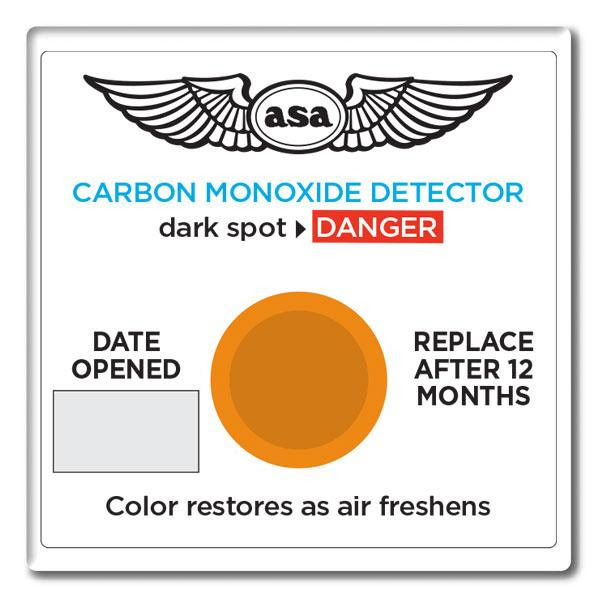
This is a passive detector, which only colors. If feeling one of the symphoms, look at the dot. If its dark, then open the windows and land as soon as possible. There are also active detectors available just like in your home.
Important things about Carbon monoxide and flying
- Be alert when feeling light symptoms
- Be alert on exhaust gasses in the cockpit
- Have a CO detector, recommended is an active that makes noise if it detects something
When having symptoms or an alert that goes off, do these things:
- Turn off the cabin heating
- Ensure fresh air goes into the cockpit, for example by opening an window
- Use supplemental oxygen if on board
- Land as soon as possible, or do a precautionary landing
- Call a doctor
- Investigate the aircraft by a certified organization after landing
By breathing fresh air, the elimination of carbon monoxide from the body can speed up.
Hyperventilation
Hyperventilation is usually caused by stress or anxiety, leading to excessive breathing that lowers carbon dioxide (koolzuurgas/koolstofdioxide) levels in the blood, which then produces the characteristic symptoms:
- Dizzyness or light headed
- Short breathing
- Feeling tingling in hands, legs or around the mouth
- Muscle cramps or decrease in muscle power
To solve an ongoing hyperventilation, let the person breathe into a small waste bag. This will breathe in some carbon dioxide (CO₂), and will increase the CO₂, which solves the symptoms.
Hyperventilations can also happen fysiologic when fitnessing or working out. The human body will then on purpose have less O₂ in its blood and will increase the breathing rate to compensate for it. This is normal behaviour.
Expansion of closed gasses
In the human body, there are some cavities which are filled by air or gasses. With an increase of altitude, this atmospheric pressure will increase and those gasses will expand.
Complaints caused by expansion of those gasses can occur in several organs like the middle ear, paranasal sinus (neusbijholtes), the gastrointestinal tract (maagdarmkanaal) and teeth. Symptoms can be feeling little to severe pain.
Middle ear
The middle ear is linked up by the eustachian tube (buis van Eustachius) with the nasopharynx (neuskeelholte). This helps having the air pressure on the eardrum equal.
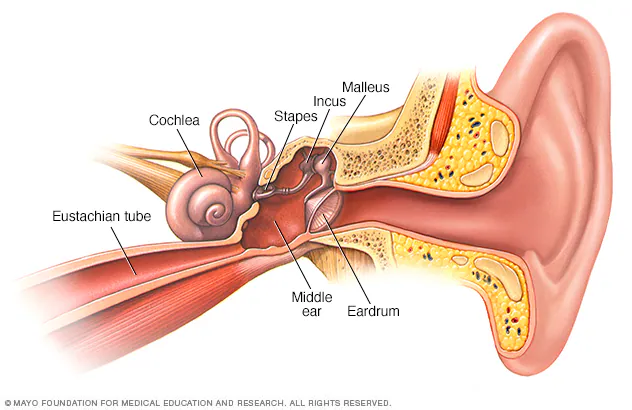
If the nasopharynx swells up by a sinus infection or hay fever, the eustachian tube can be constipated. When increasing or decreasing in altitude, this leads to a pressure difference between the middle ear and the atmosphere. This can cause the eardrum to bend in or outside.
This is why it’s not a great idea to fly if having a sinus infection because it can permanently damage your hearing.
When having this, you can get pain in your ears, pressing feeling or even cracks in the eardrums. This is called barotitis.
The eustachian tube is designed that air can easily escape through the middle ear. When climbing in a plane, most people doesnt have that much problems. The most problems are when descending, where the pressure will increase rapidly.
Barodontalgia
Barodontalgia is where teeth give a lot of pain because of the pressure difference. This pressure pushes on the teethnerves causing this pain. This goes away in time, as the pressure equals.
The circulatory system (2)
The circulatory system (de bloedsomloop) is the transportation of blood throughout the body. Blood transports oxygen and nutrients to organs and body tissues and collects garbage in the form of carbon dioxide (CO₂) and other garbage. The engine of this circulation is the human heart.
The heart is a specialized muscle which is a double pump:
- The left half pumps blood around the body which is called the big circulation
- The right half pumps blood to the lungs which is called the small circulation
The heart pumps around 60 to 80 times per minute at rest.
Regulation of heart rate
The heart rate will be controlled primarily by the sinus node (sinusknoop), which is a nerve node (zenuwknoop) in the heart itself. The speed where the node will fire signals is influenced by hormons like adrenaline.
Blood vessels
Blood vessels are tube-like structures in the human body where blood flows through. There are 3 types of blood vessels:
- Arteries (slagaders): These carry oxygen-rich blood away from the heart through the human body. The aorta is the big body arterie that comes directly from the heart
- Veins (aders): These carry blood back to the heart after the oxygen and other stuff is depleted from that blood
- Capillaries (haarvaten): These are called this because those are the thinnest blood vessels. They ensure blood reaches the body tissues in cells and waste products are moved back in the blood
The coronary artery (kransslagader) is the road of blood to the heart itself.
Blood pressure
Blood pressure is the pressure of the blood vessels in the big circulation. This pressure is a result of the heart pumping in a certain speed. Blood pressure is measured in the two stages, and gives a double number. For a normal adult, the healthy blood pressure is 120/80 (mmHg or inches of mercury).
- Systolic pressure (overpressure): This is at the moment of contraction (samentrekking) of the heart and reaches about 120 mmHg
- Diastolic pressure (underpressure): This is the moment of underpressure between contractions where the pressure decreases to about 80 mmHg
This gives us the 120/80 healthy condition which can defer for every person.
Regulation of blood pressure
Most organs can survive some time without blood supply, but the human brain is very sensitive at variation of blood supply. This is why the human body consists of baroreceptors. These are pressure-sensors which are in the aorta and arteries which will measure the blood pressure. A low blood pressure is then corrected by increasing the heart rate or increasing the force of pumping.
Cardiovascular diseases
Cardiovascular diseases (hart en vaatziekten) are the primairy cause of death in the western world. One because its a broad term and 2 because we are not living very healthy. Incidents that could be categorized as cardiovascular diseases are:
- Heart attack
- Angina pectoris
- Cerebral infarction (herseninfarct)
These diseases are caused by atherosclerosis, which means that the veins are full of calcic (kalk). This will then also cause bloodstols which is called thrombosis.
An heart attack and angina pectoris are coronal heart diseases. This is when the coronal veins/coronary arteries (kransslagaders) are affected. If one of the coronary arteries slits up by atheroscerosis, a part of the heart muscle will die because of a oxygen deficiency (zuurstoftekort). This is the definition of a heart attack. A cerebral infarction for the brains is the same principle.
High blood pressure
At a high blood pressure, also called a hypertension the diastolic pressure is higher than 90 mmHg and the systolic is higher than 140 mmHg. A mild increase of the blood pressure will not give symptoms, but is one of the critical causes of atherosclerose and with this other cardiovascular diseases. When having a blood pressure of 160mmHg/95mmHg or higher, you will not pass the medical certification (class 2) you need for a PPL license.
The causes of hypertension can variate between such different items:
- High body weight (BMI above 25)
- Unhealthy food
- Not enough physical exercise (less than 150 minutes per week)
- Genetic factors
Accelerations during maneuvers
During normal conditions with normal gravity, a human is exposed to around 9,8 m/s of gravity. During maneuvers, this can increase where the power on a body can heavily increase. We will call this G-forces or gravity-force. This number states the force and is a factor of how heavy you feel opposing the gravity.
| G force | Description |
| 1 G | In steady flight, you feel as heavy as you are |
| 3,5 G | When pulling the yoke, you will feel 3,5 times as heavy as normal, feeling pushed into your seat |
| -1,2 G | When pushing the yoke, you will feel much lighter and will come out of your seat |
- Positive G (+G): Blood is pushed toward the feet. This can reduce blood flow to the brain and may cause blackout or tunnel vision, like as we learned, the brain needs oxygen to function and we disrupt this
- Negative G (−G): Blood is pushed toward the head. This increases pressure in the eyes and head and can cause a red-out, where vision turns reddish
Humans usually tolerate positive G better than negative G because the blood vessels in the head are more sensitive to increased pressure. In both cases, its heavily recommended to stop your maneuver and keep the plane level.
- The human brain has a oxygen storage of about 5 seconds
In fighter jets, the pilots have a special suit (g-suit) which is very tightly around the stomach and contains pressured air. This helps the flow of blood and stops it from going to the feet. They are also specially trained with breathing techniques where they can be exposed to 9G for a small time, where normal people will pass out at around 4-5g for some seconds.
The eyes (3)
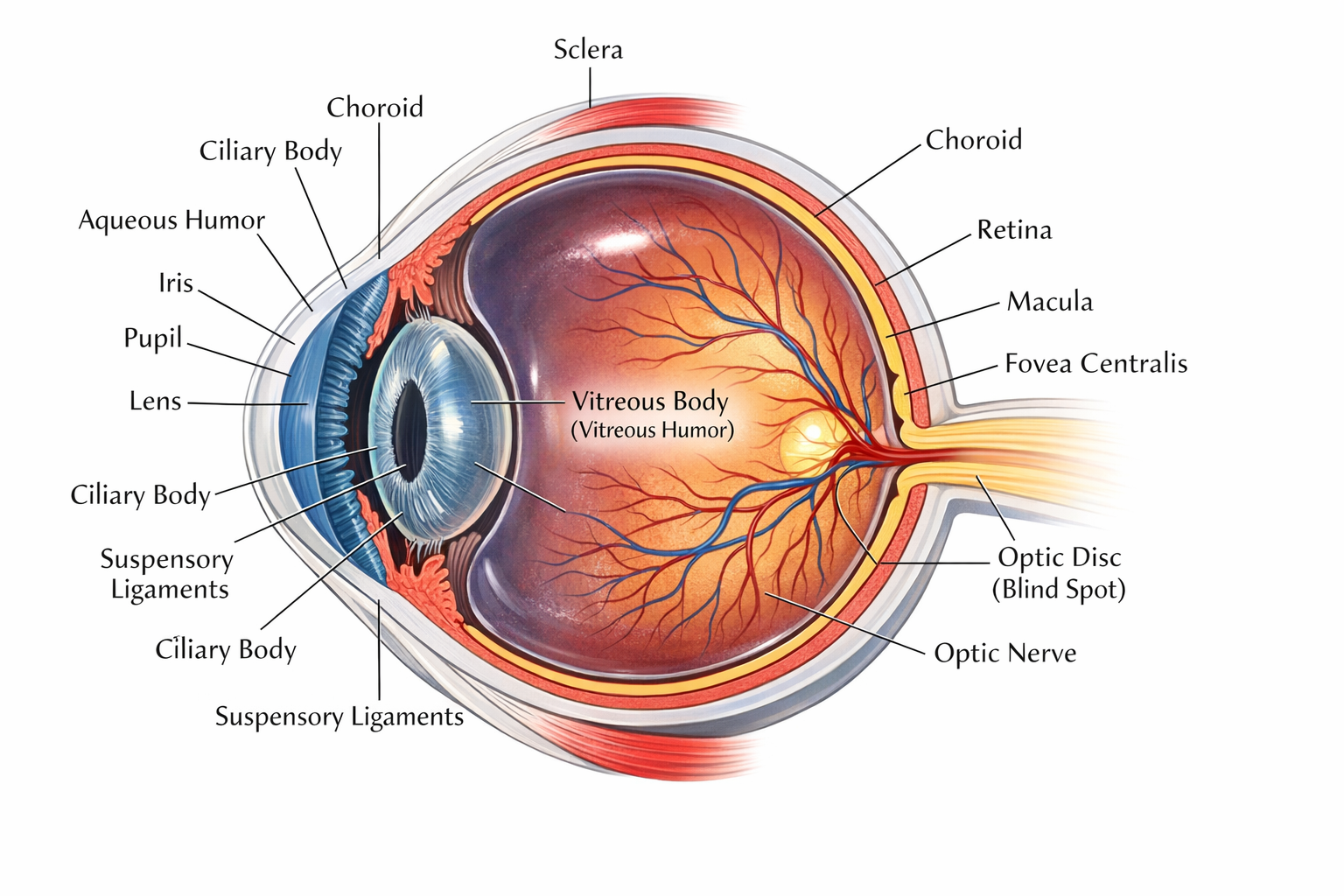
Eyes of a human person are built from glass-like material, which is a clear and jelly like liquid. The inside of the eye is for the biggest part the light-sensitive retina (netvlies). At the front of the eyeball, there is a lens and iris, which is the rainbow-membrane and the diaphragm of the eye. The pupil is the central opening in the iris.
From retina to view
The eyes work realy similar to how a camera works. Light will be projected by the lens onto the retina which consists of light-sensitive cells. The signals of those cells will be transported by the eye-nerve to the brain. In the brain is the view converted to real pictures the human can see.
The iris is really similar to the apperture of a camera. In low-light area’s, it will become bigger to cach more light where it becomes smaller in light-rich area’s to compensate for the heavy amounts of light.
Cones and rods
In the human eye, we have 2 components which helps getting a good view:
- Cones (kegeltjes): Are used for seeing sharp and details, but not for light. They are connected all to a single cell -> parralel
- Kegeltjes -> Kleur + detail
- Rods (staafjes): Are used seeing in the dark, their light-sensitivity is 10.000 times higher than rods. Cones are less great for seeing sharply as they are all connected to some cells -> serial
- Staafjes -> Nachtzicht
| Property | Cones | Rods |
|---|---|---|
| Main function | Vision in bright light and color vision | Vision in dim light / darkness |
| Light sensitivity | Lower sensitivity to light | Much higher sensitivity to light |
| Sharpness / detail | High visual acuity, good for fine detail | Lower visual acuity, less sharp detail |
| Neural connection | Often linked more individually, allowing precise vision | Many rods converge onto fewer cells |
| Best at | Seeing color and sharp details | Detecting light and movement in low-light conditions |
Area of view
The area of view a human person can see is circle-formed and is around 90 degrees long to 60 degrees up.
Central viewing part
The rods are concentrated on the yellow part, called the macula lutea. The center of the yellow spot is called the fovea and only consists of cones, without any blood vessels between. There is a very small area where you can see very sharp, of around 5 degrees up and width. This is the text you are now looking at.
Peripheral visual field
In the part of the retina outside of the yellow spot, we have the peripheral visual field (perifere gezichtsveld). This part only consists of rods and you will not see very sharp in this part, but its great for seeing better in the dark. Our eyes are a combination of both things, making it all round. This part only has 10% of the sharpness of the central viewing part.
Blind spot (Optic disc)
At the part of the retina where the nerves converge and transition into the eye-nerve, we dont have light-sensitive cells. This is the blind spot, called the Optic Disk. This sits around 15 degrees outside of the view of every eye.
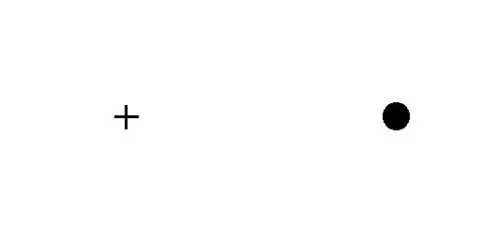
To test your blind spot:
- Cover your left eye and stare at the cross with your right eye
- Now slowly move towards the computer screen while still staring at the cross with your right eye
- At somewhere around 30 centimeters inches from the computer screen, the black circle will disappear. This is the blind spot of your eye
Viewing sharpness
The visus is the rate of detail which we can see. The visus of the eye is always linked to the central viewing area. An eye with normal sharpness can separate details with the size of one arc minute (boogminuut). This is equal to:
- A line of 1,75 mm thick at 6 meters distance
This is called visus 6/6, 20/20 or 100%. Young children can have even more than 6/6 or 100%.
The sharpnmess is dependent on several factors:
- The amount of light, too much or less light means no sharpness
- The contrast of the object
- The refraction status, which is weaker in two conditions: nearsighted and farsightedness
Accomodate
Accomodating means setting your eye sharp. The lens of the eye can make itself ball or flat, respectively for seeing close by or far away. This proces is a lot harder from 40 years old where this completely stops around 65 years old. This is called presbyopia.
Refractive errors
Some people have a different shape eyeball, which means no sharp vision can be projecten onto the retina. The most occurring types are:
- Myopia: Nearsightedness. You can see nearby objects clearly, but distant objects look blurry. (Bijziendheid)
- Hypermetropia: Farsightedness. You can see distant objects more easily, while nearby objects may look blurry. (Verziendheid)
- Astigmatism: A common vision condition where the eye is not perfectly curved, causing blurred or distorted vision at different distances.
Having such errors can speed up the presbyopia process when becoming older.
Depth-perception
To estimate distances between objects as person, we need to see sharply in the distance. The brain will use both binocular as monocular reference points to convert visual information to a three-dimensional vision.
- Binocular: using both eyes
- Monocular: using one eye
Stereopsis
Stereopsis is the process your brain takes to combine two slightly equal visions into one big vision. Its making a panorama-picture realtime, the whole day long.
Night vision
For seeing properly in low light environments, we use the rods in our eyes. The cones are barely adding something to this in low level environments.
The rods are outside of the yellow spot, thus the central vision, which is the reason you sometimes have to look about 5 to 10 degrees away from an object in the dark to actually see it.
Dark-adaption
For the most effective night vision, the rods have to adapt themselves to the darkness. This can take up to 30 minutes and will make a human eye about 1 million times more light sensitive. This is the reason when flying in the dark, the lights on board are also dimmed greatly. In case of emergencies, we dont have to adapt our eyes to the darker environment outside of the plane.
In the first 10 minutes, the cones will be more sentitive but the rods will take over after that. The speed depends on the first and second environment. How bigger the difference is, how longer the adaption takes.
Light-adaption
Light adaptation is much faster than dark adaptation because the eyes are adjusting to light that is already available. At night flights, the cockpit and cabin lights are mostly red to not expose too much blue light. Blue light makes the light/dark adaption proces longer.
Eye defects
We have some bugs that people can have with their eyes:
- Cataract (Staar): A defect where the lens of the eye becomes cloudy, causing blurred or dimmed vision (mostly happening above 45 years old)
- Glaucoma: A group of eye diseases that damage the optic nerve, often linked to high pressure in the eye, and can lead to vision loss
The hearing (4)
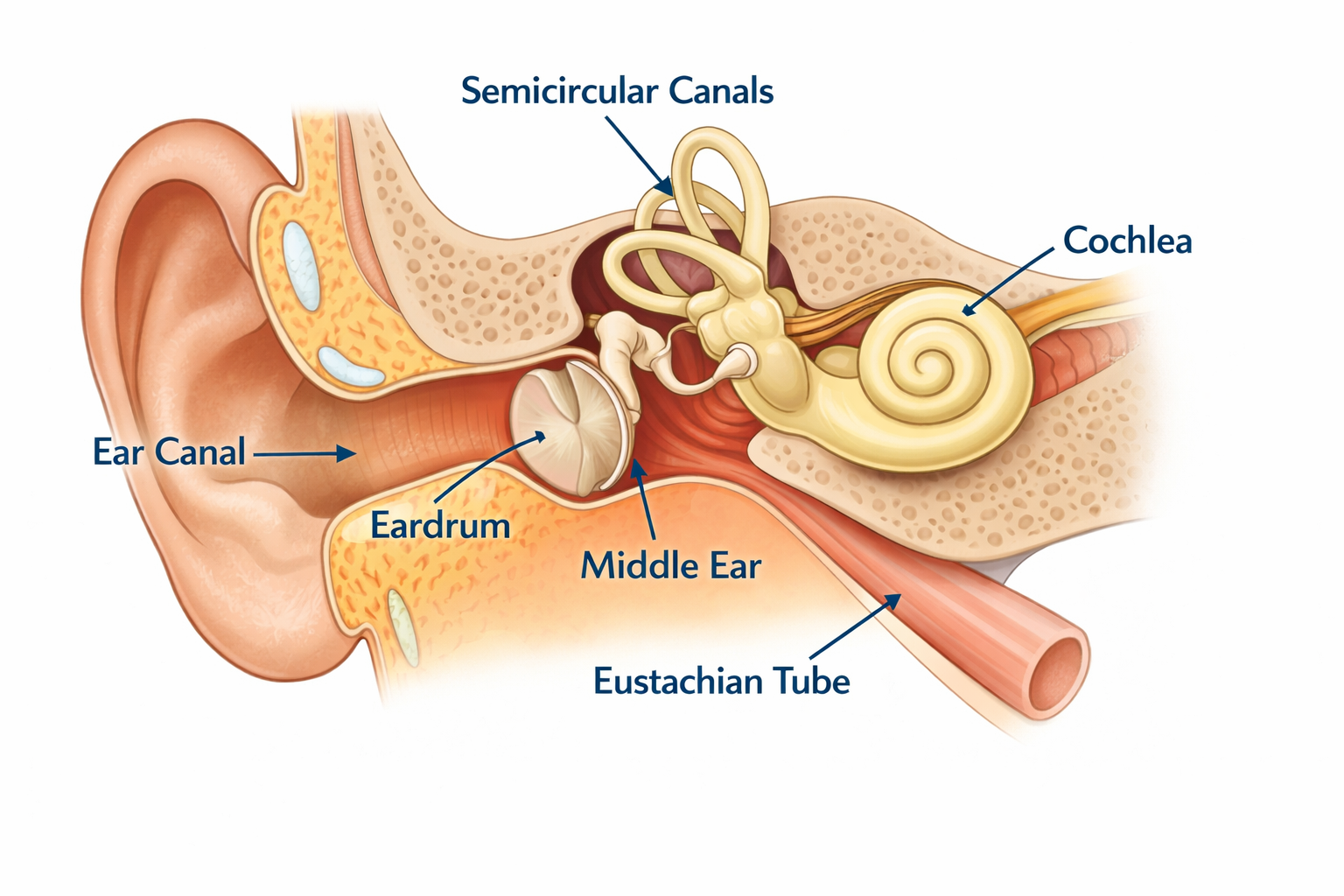
The hearing organ consists of 3 parts
- The outside ear
- The middle ear
- The inside ear
Lets take a look at this picture:
Outside ear
The outside ear is the outside part containing the ear-auricle (schelp), the ear canal and the eardrum. The auricle catches sound and will lead that into the ear canal. This will cause the eardrum to vibrate and convert the signals to the brain.
Middle ear
The middle ear is a air-filled hollow pipe connected to the Eustachain tube and this tube is connected to the nasopharynx (neuskeelholte). With this connection, the pressure can be similar in both the inside and outside ear.
The cochlea is the actual hearing organ, which is filled with moist. The vibrations of the eardrum will transported to the cochlea using some small bones. In the cochlea, some vibration-sensitive hairs are available which move with the sound and this transfers to the ear-nerve to the brain.
We also have the vestibule, which is the organ of equilibrium (evenwichtsorgaan).
Inside ear
The inside ear consists of the Cochlea and the Vestibule and can witness turning increases, linear increases and sound.
Sound waves
Sound is fast air pressure changes which the hearing organ can witness. These air pressure changes are called sound waves and are indicated in Hertz (Hz). 1 Hertz means one vibration per second, where human speaking sits from 500Hz to 3000Hz
The amplitude of the sound means how loud the sound is, measured in Decibel (dB). The decibel ratio is exponential, where every 3dB increase means twice the amplitude.
Ear defects
The ears and soudn transported to the brain can decrease over time. We have multiple types of defects:
- Conductive hearing loss (geleidingsverlies): This means when the cause sits in the ear canal, ear drum or middle ear
- Perceptive hearing loss (perceptief gehoorverlies): This means when the cause sits in the cochlea or ear-nerve. This is mostly permanent and contains noise induced (NILH) and elderly loss of hearing (presbyacusis)
When exposed to high levels of sound, the sound will increase the hearing threshold. This means you temporarily perceive this louder sound somewhat more quiet, indicating that your ears will start hearing loss.
Wearing a headset in a single engine plane prevents you from having hearing defects and will make you communicate much better than shouting.
Balance and air sickness (5)
In the inside ear are 2 organs located:
- Cochlea: already discussed, organ which processes your hearing and sounds
- Vestibule: the balance organ
The vestibule itself also consists of 3 parts:
- Utriculus: a bladder filled with moist and otoliths
- Sacculus: also a bladder filled with moist and otoliths
- Semi circular canals: These are three canals filled with moist, 1 is horizontally and 2 vertically
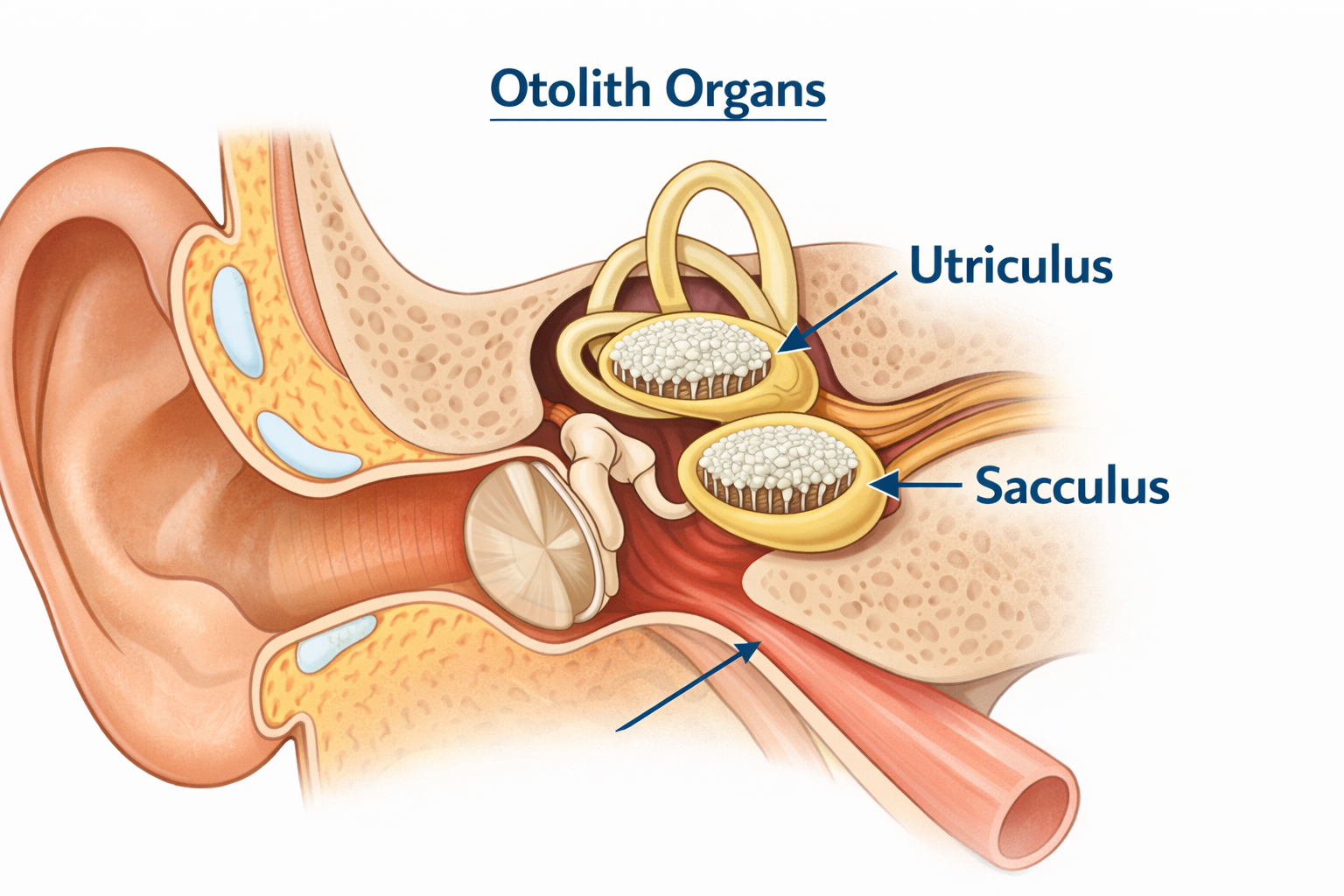
Otoliths
The otolith organs consists of 2 groups of hair cells which will be covered by a gelatined layer. At the outside, there are some calcium carbonate crystal which are the actual otoliths itself.
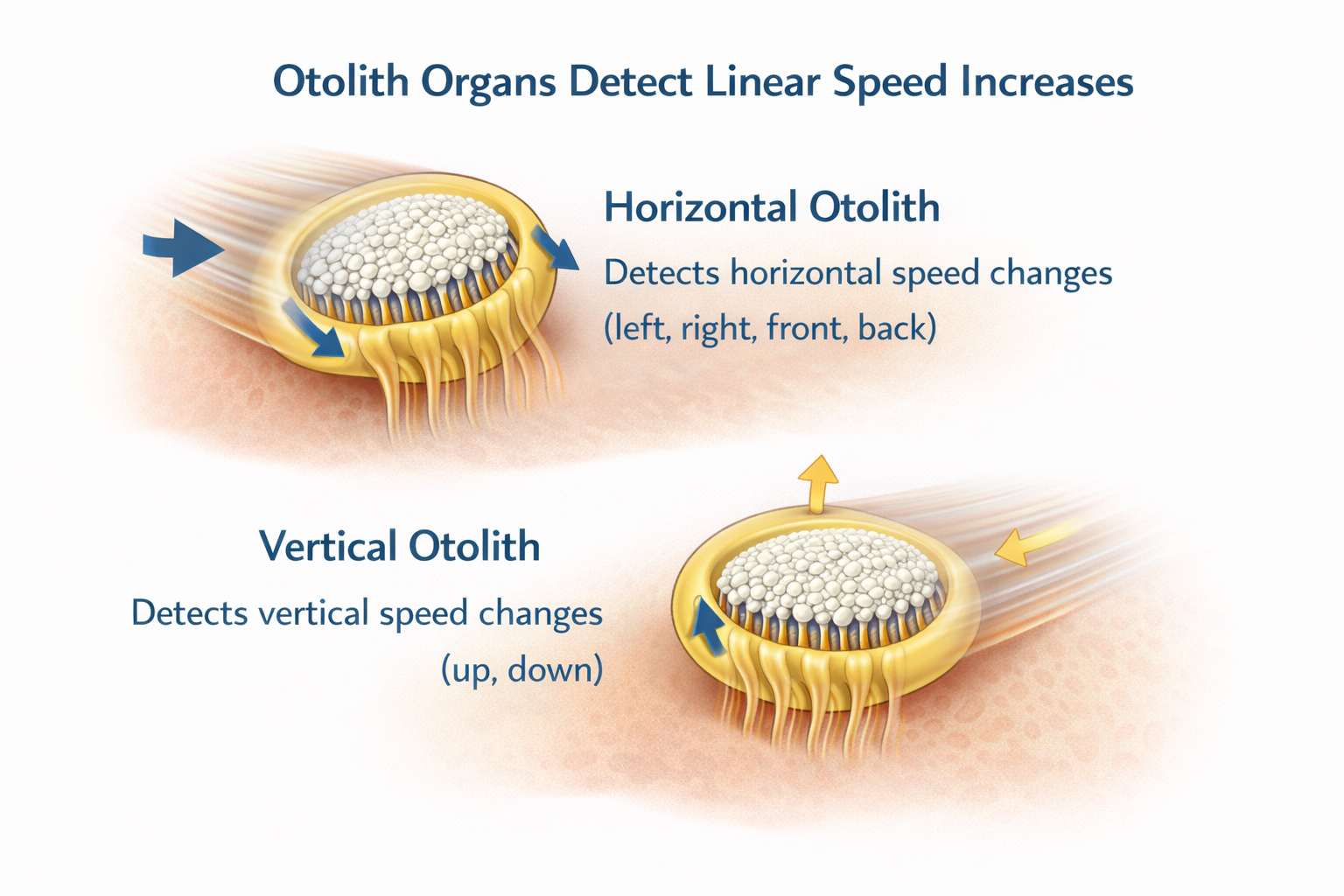
These two groups each have their weaknesses:
- The horizontal otolith is sensitive for horizontal speed changes (left, right, front, back)
- The vertical otolith is sensitive for vertical speed changes (up, down)
These organs detect linear speed increases. The otoliths have a higher density than the moist around, they will glow a little bit behind. The hair cells will move similarly and this gives us the feeling of moving.
Semi-circular canals
The semi circular canals are the three “half-circles” you see at the ear schematic. These canals are filled with fluids where one lays horizontally and the other two vertically. These canals detect angle speed increases as they both make an angle of 90 degrees and can detect rotations around all three axis:
- Roll
- Pitch
- Yaw
When the head rotaties, the fluid will have a short latency because of mass-slowness. The movement of the fluid will be picked up by the small vibration hairs. If the rotation speed will stay the same, the feeling will disappear after a while when the fluid is stabilized.
Both the Otolith and semi-circular calans have a perception threshold, which must make a speed increase to notice. If the fluids don’t move at all, we can get illusions, like we don’t percept movements at all. The balance-setting will be applied when no speed increases are being percepted.
The balance-organ is not designed to feel a difference in gravity and centrifugal force.
Semi circular canals are sensitive for angular accelerations (hoekversnellingen/draaiversnellingen).
Air sickness (also called travel sickness)
Air sickness is a movement sickness which is really similar to car sickness. It is primairily caused by contradictory information from seeing and feeling in your body. Flying with people that cannot see the horizon can also cause this.
Symptoms of air sickness are:
- Nausea (misselijkheid)
- Throwing up
- White-face
- Transpiring (cold sweat)
- Heart-poundings
- Hyperventilation
- Sleepyness
Air sickness can hugely decrease the normal functions of a human person. Good to know as pilot.
Air sickness is less common for people like pilots as they control the plane and are in sync of what they see, do and feel. Focussing on controlling a plane also helps getting enough cognitive effort.
One way to manipulate the body of passengers who are getting air sick easily is to give them some tasks, like making pictures of buildings, looking out for certain points of interests on the ground or help to look out for other traffic. This doesnt have to be al real task you need, only to keep them busy.
After a person is exposed multiple times to certain plane movements, the sickness will go away as the person adapts to the movements. Also avoid turning your head in situations with turbulence or heavy winds, as this also manipulates the semi-circular canals.
Perception and orientation (6)
A human is continiously aware of the state of the body against the environment around it. This capacity of aerial orientation is the result of 3 components:
- Vestibilar device: delivers information about the direction of gravity and speed changes
- Proprioception: This exists of nerve-endings in the human skin, muscles and joints. Basically everyting you feel including intuition
- The eyes: The eyes deliver the visual image. This is 80% of the full orientation-process
The combined information of these 3 systems will enable us to do handlings and coordinate movements. When one of those three will stop functioning or delivers wrong information, most all-day tasks are becoming very hard to impossible.
Because of all these instruments our human body has, there is a very important rule to note:
- Disregard your feelings when controlling a plane
In a plane you will move around and fly horizontally just because your eyes see a straight horizon. When flying without any sights and on feeling, you will end up losing control over the aircraft within 60 seconds and even faster when banking.
Desorientation
Desorientation happens when the perception and orientation stops working. Your human body who was designed to feel and coordinate on the ground is tricked into things that do not happen actually. This is called an illusion, which is basically an incorrect perception.
Examples of illusions are:
- Leans: A pilot may feel that the aircraft is banking even when it is actually level, or feel level after returning from a real bank. This can lead to incorrect control inputs as the pilot tries to “correct” a false sensation.
- Coriolis Illusion: This happens when the head is moved during a prolonged turn, creating a powerful sensation of tumbling or spinning on a different axis. The result can be severe disorientation and an inappropriate attempt to recover from a motion that is not actually happening.
- Somatogravic Illusion: Rapid acceleration can create the false sensation that the aircraft is pitching up, while deceleration can feel like pitching down. This may cause the pilot to push or pull the controls incorrectly, especially during takeoff or go-around.
- G-Effect: High or changing G-forces can distort a pilot’s sense of pitch and attitude. This can result in a false perception of the aircraft’s position and lead to dangerous control errors.
The Leans illusion is the most happening illusion and can be very dangerous if not treated correctly.
Visual illusions
We also have visual illusions, where we percept things differently than they are really.
- Approach and Landing Illusions: Visual cues during approach can make the runway appear higher, lower, closer, or farther away than it really is. This can lead to an unstable approach and an incorrect glide path. This is especially important at runways with a slope angle.
- Strong Lights and Contrasts: Bright lights, dark surroundings, or sharp visual contrasts can distort depth perception and distance judgment. As a result, the pilot may misinterpret altitude, alignment, or rate of descent.
- Autokinesis: A small stationary light in darkness may appear to move when stared at for several seconds. This can cause the pilot to mistake the light for another aircraft or to follow a false visual reference.
- False Horizon: Sloping cloud formations, shoreline lights, or ground patterns can be mistaken for the true horizon. This may cause the pilot to align the aircraft with a misleading reference and enter an unsafe attitude.
To avoid desorientations, the most important rule is to not do VFR in Instrument Meteorological Conditions (IMC). Stay alert and keep your situational awareness and use the IM SAFE checklist.
Looking out
In VFR flights, we mostly fly with the see-and-avoid principle, where we constantly look out for other traffic and avoid them as much as possible by sterring to the right. ATC does only completely separate VFR traffic in Class B airspace (Also in A, but we are generally not welcome there as VFR).
To look out for other traffic, we use a method called scanning, where we will keep a good picture of the fromt 180 degrees viewing field in front of the plane. We can switch for around 10 degrees and at least one second to actually separate the details/clouds from real threats in the air.
Some limitations of this principle aire:
- Human facturs
- Fast movers
- RAM-course, where other traffic keeps a constant relative bearing from our plane
- Hear is see
This is why we would always sign into Traffic Information Services, have our Transponder enabled and TCAS if built in.
Flying and healthiness (7)
Flying in a wrong condition is prohibited by the dutch “Wet luchtvaart”. Before even thinking of touching a plane, we must first run through this IM SAFE checklist:
- Illness
- Medication
- Stress
- Alcohol
- Fatigue
- Eating
Illnessses/sickness
Someone who is really sick will not feel like flying. If not functioning properly in day to day tasks, you wouldn’t be flying either. We can have several idderent types of sicknesses:
- Sinus infection
- Hay fever
- Gastrointestinal disorders (Maagdarmaandoeningen)
- Infections
If flying with a sinus infection or hay fever, the chance of these two symptoms is greatly increased:
- Pressure vertigo
- Pain in the frontal sinuses and paranasal sinuses
Medicines
When a pilot uses medicines, there are some things to look after:
- Possible side effects
- If the results are enough for flying an aircraft
If you are using medicines to suppress pain or other things, you must ask yourself if fit-to-fly. Some regulatory rules that forbids flying in these certain conditions are:
- Using medicines which can disrupt safe flight execution
- Be aware of possible decrease of medical condition
- Pilots are required to ask for advice if having any chronical sickness or medicines
Coughing medicines
There are some medicines against coughing, which work by supressing the cough reflexes in the brain. They also give some feeling of sleepyness.
Ephedrine and other dangerous medicines
In some countries, we could buy cocktails of different medical cpmponents like:
- Antihistamines
- Adrenal cortex hormones (bijnierschorshormonen)
- Ephedrine
- Pseudoephedrine
They all are forbidden in the Netherlands because of the great side effects like sleepyness and seeing blurry.
Sleep and calming medicines
Medicines that cause sleepyness are considered one of the most dangerous types of medicines for aircraft pilots. Those medicines can cause effects up to 72 hours like:
- Sleepyness
- Less capacity for stressful situations
- Less concentration
- More vulnerable for illusions
The general guideline is when taking medicines that cause sleepyness, wait at least 24 hours before controlling a plane.
Alcohol
Flying under influence of alcohol is forbidden, just like driving. In aviation, the rules are more strict because of possible damages. The general rule is that someone drinking any alcohol must wait to 10 hours before controlling an aircraft. In reality, people can have a decreased functioning even after these 10 hours.
A person is punishable when having more than 0,2 promille, which is 90 (µg/l) micrograms per liter. This counts for everyone doing flight preparations, executions and such.
Obesity
Obesity or being overweight causes more diseases and people are a lot more sensitive to hypoxia and G-forces.
Smoking
Smoking has both short-term and long-term effects on the human body. The long term effects are primarily in diseases, but some short term effects are applicable to flying an aircraft.
- Smoking causes hypoxia around 4.000ft to 5.000ft earlier than normal people (dangerous in night flying)
- Smoking causes a light form of anemia (bloedarmoede)
- Smoking people ar emore vulnerable to carbon monoxide poisoning
- Smoking causes the overall blood flow to have less oxygen
The circadian rythm
The circadian rythm is an internal clock of the human body where the internal temperature rises when we should be awake, and drops when we should be at sleep. This temperature range is about 1 degree celcius.
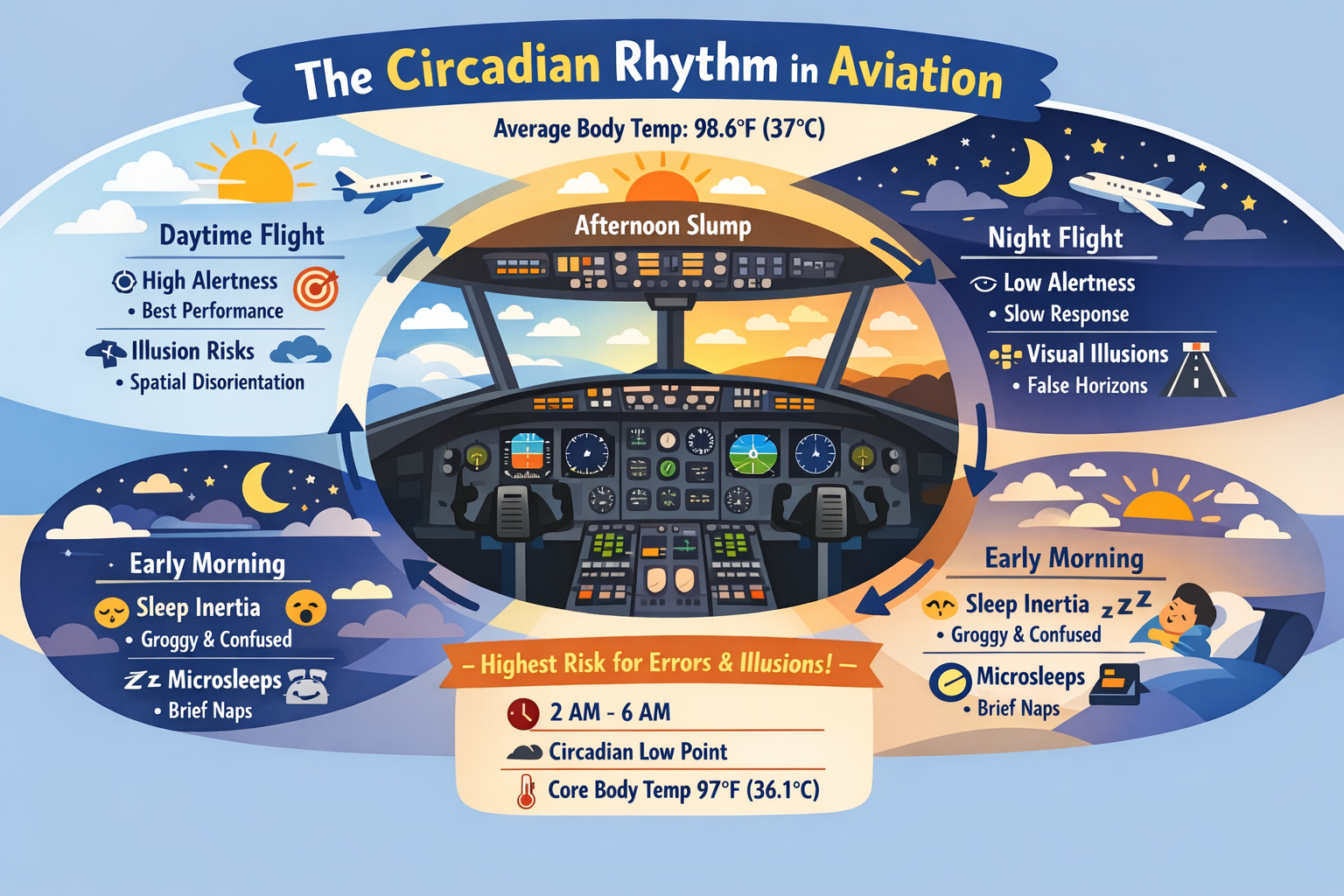
At night flying during the window of circadian low, this brings extra risks, like a decreased capacity of decision making and little less reaction-time. This is why pilots are not allowed to fly more than 10 hours per 24 hours.
Types of tiredness
We speak of two types of tirednesses:
- Acute tiredness: After speeling not well, effort or mental effort you can be exhausted and tired for a day
- Chronical tiredness: You can be exhausted over a longer period by work, stress or other exhausting activities
One way to eliminate tiredness is to do power naps during the day. This is researched and can have a positive effect on the functioning of a person.
Psychoactive stuff
ICAO defines certain stuff as psychoactive:
- Alcohol
- Opiates
- Cannabis
- Calming stuff
- Cocaine
Therefore all countries forbid the use of these stuff in combination with aviation. The only exceptions of this are coffee and tea.
Eating and dehydration
A human that has eaten too less have a low blood glucose level. This is also called “hypoglycemia”. Being hungry can cause light sickness like dizzyness, tiredness and nausea (misselijkheid).
When being dehydrated, we mean that you have drank too less. Symptoms of dehydration are:
- Dry mouth
- Headache
- Dizzyness
After ignoring those initial symptoms, more can arrive.
Information processing (8)
A human persion catches information by it senses. These senses are:
- Sight
- Hearing
- Smell
- Taste
- Touch
- Balance
The senses are more of less sensors (to talk in IT terms) which continously register information and pass it to the brain. The human brain will select and combine the needed information and how to interpret this.
The first step in the process of information processing is perception (waarneming). This is a subconscious process where the information will be saved in your memory. We cloud also call this the sensory memory. Signals will only saved for several seconds here before being overwritten by new information.
Short-term memory
After we will set our concentration on several infoemation, this will be saved into your short-term memory. This is where something we see will be converted into decisions and doing actions. However, this memory has a limited capacity of around 3 to 7 items with information, but we can prolong this items by continuously repeating it. Information in the short-term memory will reside there for a minute at max.
Some disruptions of short-term memory are
- Sensitive for external disruptions
- Parts of a clearance can be forgotten if out of time/items
For the most part, if things are in your short memory and you need them to remember for flight safety, the best thing is to write them down. This helps extending the remembrance period plus you have it written down.
Long-term memory
The long-term memory differs from the short-term memory by terms of capacity and retention-time. This part has an unlimited capacity and can save information for years.
This memory contains different categories of information:
- Implicit memory: memory without conscious effort; habits and automatic responses
- Declarative memory: memory for facts and events you can state
- Explicit memory: consciously recalled memory; largely the same as declarative memory
- Procedural memory: memory for skills and actions, like cycling or typing; a type of implicit memory
However, the capacity is unlimited of the long-term memory, but very specific information can be lost very easily. Like “hey, how did I do this 3 weeks ago”. This is why making documentation andwriting things down can really help you. Exactly the reason I started my website.
Prospective memory
The prospective memory is a small part where you think of tasks you have to do in the future. They could be forgotten if we don’t have a certain trigger (cue) for it. Like setting the altimeter on 1013hPa at the transition altitude or at work, doing something for your collegue, but simply forgot about it because no cue was given.
Exactly why we use checklist in the cockpit.
Perception
The vision that is projected onto the retina is a direct view of reality. You should think that everything will reach our brain without changes and thus is objective. However, this is called a bottom-up in the perception process.
In reality, everything we see is percepted by the brain. Depending on your activity, we expect certain things to happen, like our Cessna lifting of at 55 knots on the runway.
Human perception is not always 100% in sync with reality, and experience and exceptancy will also play their role in this:
- Selective processes: the brain focuses on some information and filters out other information; in aviation this can make a pilot miss important cues
- Subjective processes: information is influenced by personal interpretation, feelings, and past experience; this can affect judgment and decision-making
- Expectancy: the tendency to see or hear what you expect instead of what is actually there; in aviation this can lead to wrong assumptions
- Probability: how likely something is to happen; in aviation it helps assess risk and choose the safest action
This is the reason several people can have a completely different view of the same situation. An example is when flying IFR with an inexperienced pilot. The experienced pilot will carefully follow the instruments where the more inexperienced pilot will fly on perception. The experienced pilot will do this better.
Visual illusions
In an earlier module, we already described some sense-illusions but we also have some visual illusions we must know and defend ourselves against.
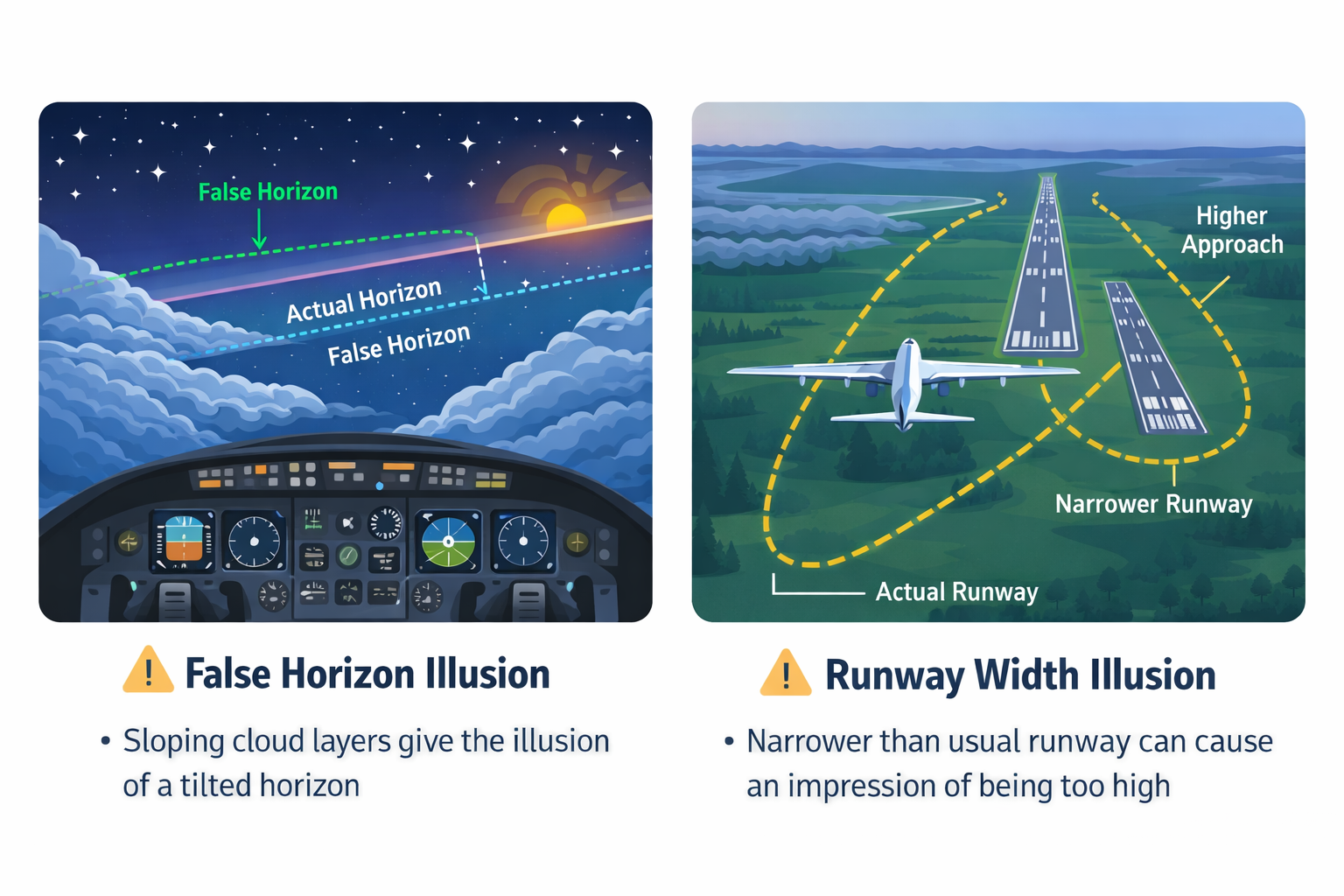
Illusions sometimes can be very tough to “un-see” but being with two pilots can help a lot. The most important is the context of where the illusion is in and this will depends on how we see and then percept it.
Attention
Attention is assigning thinking processes to certain tasks. Selecting is essential as we have a limited capacity and only want to focus on the essential parts which can be processed in our short-term memory. This is called selective attention.
A human person can delegate attention into what is called divided attention where more people, like 2 pilots, will delegate tasks to each other. This is where the principal of Pilot flying and Pilot monitoring comes from.
We also have attentional tunneling which everybody knows; thinking too long about one job and completely forget about the rest.
Vigilance
Vigilance (waakzaamheid) is the process where a person will actively be aware of the attention is spent on the right and essential things. This is important, as some repetitive tasks can lower our vigilance due to the repeating cause. This can cause adecreased level of vigilance, called hypovigilance.
Some causes for hypovigilance are:
- Sleepyness or being tired
- Eating -> after diner dip
- Monotonic sounds like engines of servers
- High temperature
- Stress and pressure
- Fast irritance and bad communication
Limiting information processing
The proces of human information processing knows some built-in limitations where we have to be aware of.
- Confirmation bias: This is a state where we expect something based on knowledge or events and we will keep searching for clues that confirm our initial bias, even when those are not even related that close
A great example of confirmation bias ending up fatal is:
A well-known aviation accident that is often used to discuss confirmation bias is Eastern Air Lines Flight 401, which crashed into the Florida Everglades on December 29, 1972. The crew became focused on a landing gear indicator light that seemed to suggest the nose gear had not locked properly. Because they were convinced the main problem was the landing gear, they directed most of their attention toward confirming and solving that issue, while failing to notice that the aircraft had begun to descend. The autopilot had been altered unintentionally, and the plane gradually lost altitude until it crashed. The U.S. investigation found that the crew’s attention was distracted from monitoring the flight instruments, allowing the descent to go unnoticed.
Automating tasks in the cockpit
Automating tasks in the cockpit can drastcally reduce workload and with that stress and such in the cockpit. Navigating with charts are replaced with tablets with GPS, autopilot for climbing and descending/cruise and other systems. However all these cool things, there are some cons about automating tasks:
- Automation complacency: where pilots trust too much on their automations, unseeing critical errors like other traffic
- Autopilot which deactivates itself after having a minor error and not hearing the beeps, causing the plane to descend from itself
Decision making and errors (9)
Decision making is a comprehensive cognitive process where a person needs to make choices. This process will start with perception and information processing, like described in the earlier modules.
In decision making, there will come a lot of human factors into play:
- Knowledge
- Skills
- Experience
- Attitude
- Motivation
- Fysiologic condition
- Psychologic condition
- Incluences from the outside like group-pressure or passenger pressure
Decision-making process
Normally, making decisions will happen in these steps:
- Observe the problem (waarneming)
- Attention on the details (aandacht)
- Think of what is needed to cause this issue (interpretatie)
- Execute a certain checklist or action (besluitvorming)
Situational awareness
To make safe and correct decisions, it is good to have a good situational awareness. This states that you exactly know what you are doing, what problem you need to solve and what things will help doing this. Also knowing where you fly is great. Without a good situational awareness you are sensitive for making errors which can lead in disasterous outcomes.
Situational awareness happens at three levels:
- Perception: catching relevant information from the environment
- Understand: based on knowledge or skills you will create a good overview of the real situation
- Forecasting: prioritizing and anticipate on what is going to happen
If this situational awareness is decreased, your own reality does not match with the actual realtity. This will improve the chance of any wrong decision (garbage in, garbage out)
Factors that decrease situational awareness:
- Bad attention spanning
- Bad communication
- Stress
- Vermoeidheid
- Too high or low workload
We can prevent and restore situational awareness by doing those things:
- Keeping the golden rule of aviation, in this order:
- 1 Aviate
- 2 Navigate
- 3 Communicate
- Admit and tell: if any doubts or uncertainties occur, speak up and just tell the situation
- Keep workload and stress levels low and prioritize
- Take your time to think and analyze and don’t do actions speedy
Good flight preparation and communication in briefings before a flight is a great way to enhance situational awareness.
Decisions and execution
To make a decision, you need to follow several steps. In the first place you need to assess the risks and the situation. Then all different options must be viewed and analyzed and the right option must be chosen which will overall give the best result.
Risk assessment and consideration of alternatives will differ from person to person. Also the pilot, plane, environment and 3rd party influence will all count towards this.
Personality and attitude
Decision making is not a objective process. Different persons will make different decisions based on the same situations. This all syncs with the personality and attitude of a person. Some persons are really fast at understanding a problem and will take a immediate decision, where other people need to write all different options down and (over)think them.
Some attitude exists, but must be prevented at all times:
| Attitude | Symptom | Remedy |
| Macho | “Look at me, im better than you” | “Don’t take unneccesary risks” |
| Anti-authoritarian | “They can go to hell” | “Rules are there to prevent accidents” |
| Impulsivity | “Do something” | “Think, than execute” |
| Invulnerability | “That will never happen to me” | “Everything can happen to anyone” |
| Resignation | “What does it matter?” | “Everyone can make a difference” |
Decision making in groups
Decision making in groups can have positive and negative effects.
- Positive effects are more knowledge, awareness and more eyes
- Negative effects is that you can exeed your personal limits and try things to look thougher than you actually are
Human error
We will call a human error such if a human decision does not stroke to the intention, leading to a unwanted result. Causes leading to human errors are liked described in earlier modules.
Human errors are for example:
- Flying into a TMA without clearance
- Forgetting carberateur heat on final
Actively violate rules are not human errors but violations with possible law-outcomes.
Learning from errors
In a human life, it is really critical to learn from errors we make or that other people make that can happen to you also. This is why every aircraft incident is thoroughly researched and the local authorities will create a final report with their recommendations described. They will fill the report with at least these information:
- Cause of the incident
- Analyzing the factors of the cause
- Report of how the incident happened
- Recommendations on how the industry can learn extensively from the errors or decisions made
The root purpose of this report is to learn from errors, not to point fingers at different orianizations and such. However, it is possible that certain organizations or individuals may be prosecuted (berecht) by law for negligence (nalatigheid) or for knowingly taking the wrong actions.
Safety culture
To learn from everyones errors, it is also important to note errors that does not lead directly to incidents. Pilots will only report their own faults if the company culture is open, and good. If the company is very toxic or closed with lots of punishments available, they will severely less open to speak about their own faults.
Therefore, in any company with pilots, there need to be a culture called “just culture”. Errors by pilots must not be directly leasding to the loss of license or work but into extra simulator training or personal training to actually become a better pilot. Only punishing and whining about errors resulting in lots of paperwork doesn’t make anyone a better pilot. Just culture must know what has gone wrong, not specifically what person did this.
It must be noted that actively violating rules and laws on purpose is a completely different story.
Stress (10)
The human body consists of mechanisms which adapts to the physical and physich threats (stressors) in its environment. The reaction of the human body is called stress, which we know 3 causes of:
- Environmental stress: temperatures, noise, lights, vibrations, turbulence, air pollution or hypoxia
- Psychological stress: Conflicts, great happenings in human life like marriage, divorce diseases, deaths, fired, changing jobs or high workload in the cockpit or fear of flying
- Physiological stress: Sickness, bad food, tiredness or alcoholusage
Note that 2 and 3 are different, altough the word might look the same.
Acute stress
Some events can cause the human body to build specific hormones, like adrenaline. This can also happen in the cockpit, where the human body will go in the primitive fighting mode. The hearts pounds faster, breathing goes faster and muscles will get more blood. This also can cause hyperventilation.
Stress has a lot of causes for a person to function, where it decreases its function level:
- Clammy hands
- Transpitating
- Vibrating hands and lips
- Dry mouth
- Hyperventilation
- Heart poundings
- Headache
- Dizzyness
- Stomach pain
Stress can therefore work against you, when in a degraded level of functioning where also having less concentration on the situation. It can also cause you to decline recently learned tactics, and do regression, where you pick up older methods you are more familiar with.
During acute stress, our body will flow through these phases:
- Alerting phase
- Resistance phase
- Exhaustion phase
Stress vs Performance
Its no suprise that stress is a primary cause of how we perform. To further clarify that, there is a graphic from Yerkes and Dodson, clearly stating how those two are related:
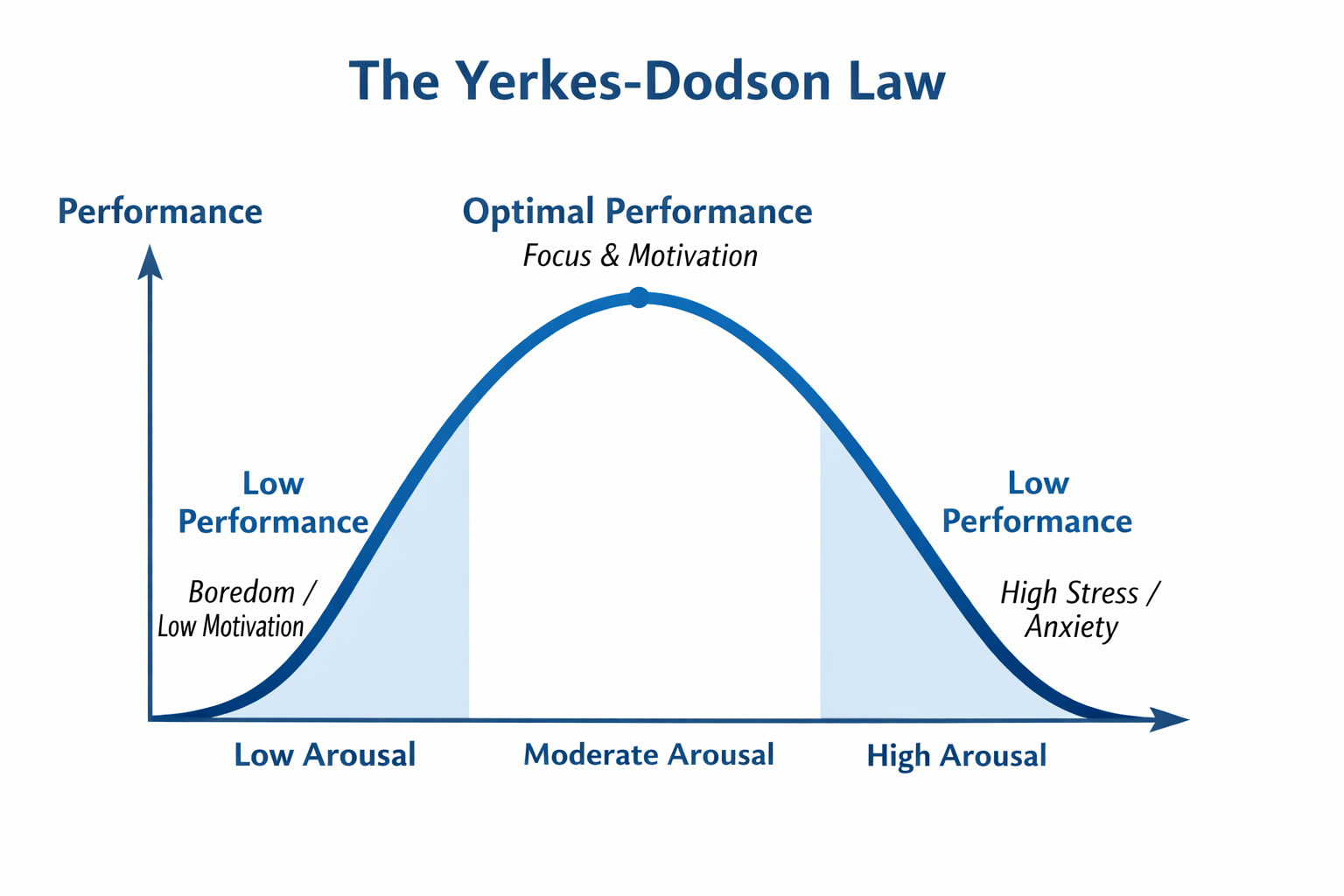
The best levels of performance are in the middle, where we have some pressure to do things the right way and at the level we need. Low stress can cause some boredom and disinterest, where high levels causes anxiety and the things already described.
Stress is also cumulative, were every waterdrop helps overflowing a glass of water.
Dealing with stress
Every person will act different under similar conditions. One person will totally overflow and freak out where the other laughs a bit and solves the situation. It all is dependent on personality and perception.
Decreasing stress levels by specific strategies s called coping, and strategies that work are different for every person:
- Stay current, deal in the current conditions
- Good flight preparation and think of what to do when and why and brief them to your co-pilot
- State personal limits, like 10 knots crosswinds or not under 5000 meters of visibility.
- Prioritize, remeber: aviate, navigate, communicate
- Dont be distracted by minor errors, fly the aircraft
- Stay calm and take your time
One final sentence to think about:
- Its better to be on the ground, wishing to fly than being in the air wishing to be on the ground
Extra information
Henry’s law
Henry’s Law states that the amount of gas dissolved in a liquid is directly proportional to the pressure of that gas above the liquid. In simple terms: the higher the pressure, the more gas dissolves in the liquid. When the pressure decreases, the gas comes out of the liquid again.
A simple example is a soda bottle: when the bottle is closed, carbon dioxide stays dissolved because of the high pressure. When you open it, the pressure drops and bubbles form.
A real life scenario of this phenomenon is decompression sickness.
Decompression sickness
Decompression sickness happens when pressure decreases too quickly, causing gas bubbles to form in the blood and tissues. It is commonly known as:
- Bends and creeps where skin itching or a crawling sensation
- Chokes where serious breathing difficulty caused by bubbles affecting the lungs
- Double vision in your eyes
Pressure vertigo
A more specific medical term is alternobaric vertigo, which means vertigo caused by a pressure difference between the two middle ears. This can happen when flying with a sinus infection.
Raw notes Theory course
HPL (Human Performance & Limitations)
Oxygen and circulation
- Arteries carry oxygen-rich blood.
- The pulmonary artery carries oxygen-poor blood (only exception).
- Blood pressure and temperature are regulated via the central nervous system.
- Normal blood pressure: 120/80 mmHg (baroreceptors).
- Composition of blood:
- Red blood cells: hemoglobin.
- White blood cells: immune defense.
- Platelets: clotting.
G-forces
- Pulling the yoke = positive G-force.
- Pushing the yoke = negative G-force.
- Increased G-force can cause loss of consciousness (less blood to the brain).
- Negative G-force is more dangerous.
Hypoxia and breathing
- Hypoxia = oxygen deficiency due to insufficient oxygen/blood supply.
- At night: maximum 5,000 ft without supplemental oxygen.
- Dark adaptation is lost faster than visual acuity.
- Carbon monoxide cannot be smelled (CO itself is odorless).
- Flushed cheeks.
- Exhaust gases contain carbon monoxide.
- Hypo = too low.
Physiological vs non-physiological responses
- Physiological: due to physical exertion.
- Non-physiological: due to anxiety/stress.
- Yawning is associated with tingling in the fingers.
- No tingling.
- Tingling present.
Barotrauma and pressure
- Barotrauma = pain caused by pressure differences.
- Pain during descent → stop descending.
- The eardrum is airtight.
- “Popping” ears → descend or climb more slowly.
- Frontal sinus.
- Gases and pressure differences with altitude changes.
- Teeth: toothache due to pressure differences.
- Eustachian tube.
Vision and perception
- The eye is remarkable.
- The eye is a light-sensitive organ.
- The iris works like a camera lens.
- Eyes accommodate by adjusting focus.
- Fovea (yellow spot).
- Light-sensitive cells (rods and cones).
- Saccadic movements → processing pause.
- Visual illusions and perceptual loss → noise/deafness.
- Semicircular canals (balance).
- Otolith organs (acceleration).
- Airspace.
- Motion sickness → focus on horizon.
- Passengers.
- Symptoms: quiet.
- Rapid changes → flying is a bad idea.
- Perception threshold.
Importance of vision
- Eyes are very important (±80% of information).
- Vestibular system = balance → integration.
- Proprioception = body position.
- Disorientation Type I = unrecognized.
- Disorientation Type II = recognized.
- Fluid in balance organ causes sensation of turning.
- After some time it feels stationary.
- 2 seconds or after-image up to 48 hours.
- The Leans → sensation of banking.
- Coriolis illusion → semicircular canals.
- Somatogravic illusion → linear acceleration (e.g. during takeoff).
- Approach illusion is dangerous → PAPI helps with glide path.
- Runway shape.
- Flicker vertigo (e.g. helicopter) → light flicker effect.
- Scanning is important.
- Peripheral vision is important.
Fatigue and substances
- Fatigue:
- Poor vision.
- Alcohol use.
- Stress or high workload.
- Hay fever and colds.
- IM SAFE checklist.
- Sleeping pill: 24 hours.
- Long-term medication: 7 days.
- Alcohol: ±90 mg threshold.
- Would you fly under the above conditions?
- Smokers operate at a higher “physiological altitude” (less oxygen).
- Coffee: max 3 (in moderation).
- Attention is not always primary.
- Vigilance = sustained alertness → short-term attention.
- Hypovigilance = too low attention level.
- Task importance.
Situation awareness
- Perceive.
- Understand.
- Predict.
Human performance (Rasmussen model)
- Skill-based → routine.
- Rule-based.
- Knowledge-based → confirmation bias.
- Order is important.
Personality = genetics and environment. Non-punitive vs Just Culture → no punishment approach.