PPL Theory - Principles of Flight (POF)
Categories:
For a live overview of my flight lessons, visit: https://flighttools.justinverstijnen.nl/flightlessontracker
This page can contain a collection of personal notes, steps to remember, finished and unfinished content. Please excuse brevity.
Do not use specific information given like fuel flow, landing/take-off distances for your flights. Always refer to the POH of your exact plane for flight preparation. My information is just for references that I used.
Lift
Lift is a component that keeps a plane in the air. This is the upward force that fights the gravity/weight of the plane. It works basically as the wind flows over and under the wing. As the air over the wing goes faster and under goes slower, it will combine at the end of the wing.
The principle of Bernoulli states that fluids/air going faster means lower pressure. Fluids or air going slower means high pressure. This is the same idea of a garden hose which you pinch. The water wil go faster in that spot but at a lower pressure.
How an airplane generates lift
Lift works basically with these 4 components:
- Wind velocity: The more headwind (speed) you have, the more air and air molecules will hit your wing. This pushes the wing upward where the wind will then be directed to the ground and changes the velocity. Changing the direction and velocity of this wind has a reaction which is lift force.
- Angle of Attack: The angle of attack is the angle of the wing hitting the wind. By default, planes have a little angle of attack of a few degrees but we can increase this with the yoke (steer) of the plane
- Drag: The drag component is how much air resistance we have in a particular situation. The higher the angle of attack, the more drag and how harder the engine must work to compensate for it, which can evantually result in a stall
- Lift force: The lift force is the resultant of the wind velocity, drag and the angle of attack and states how much the wing is pushed up
Let’s take these 4 components into a simple drawing:
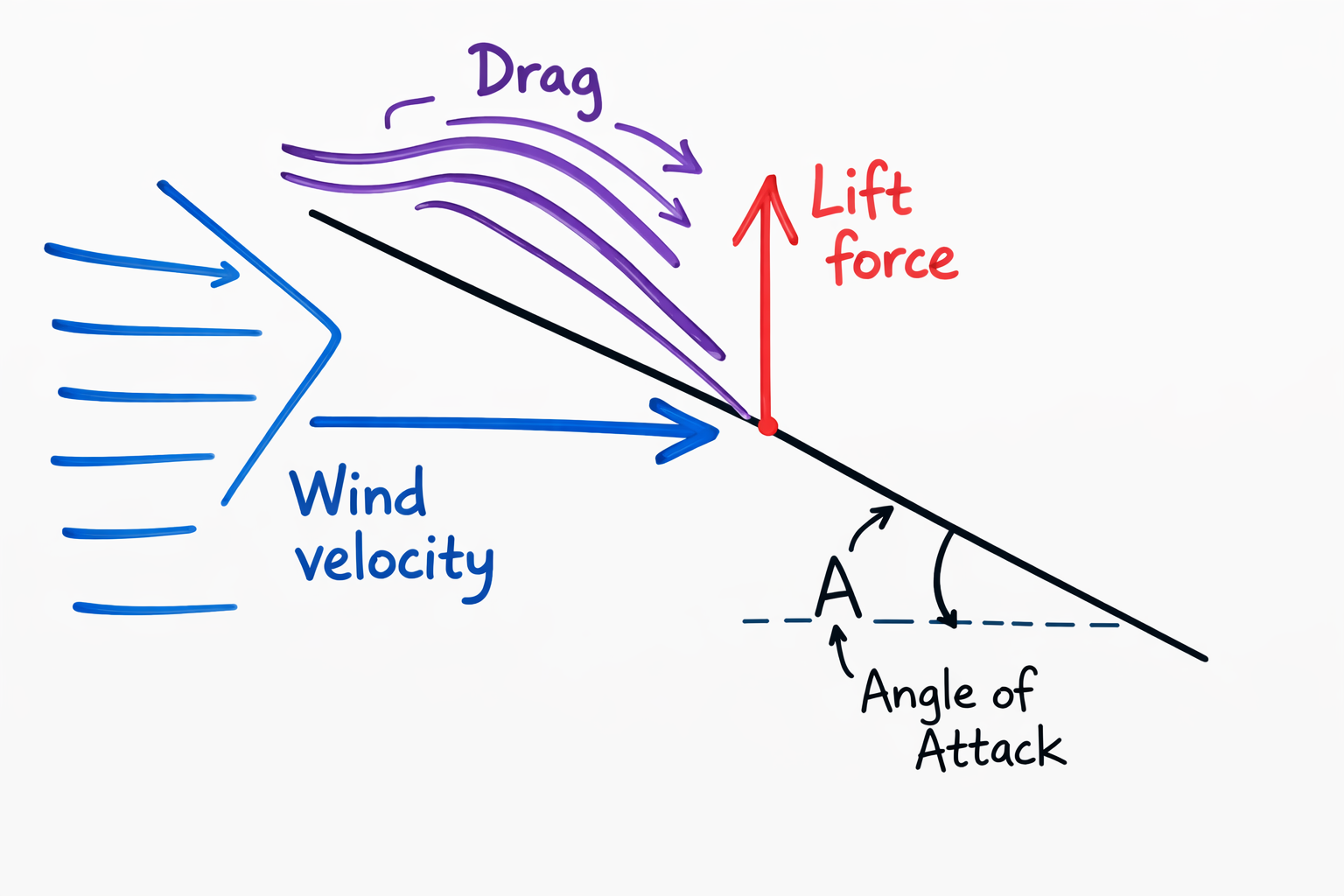
The black line represents the chord of the wing.